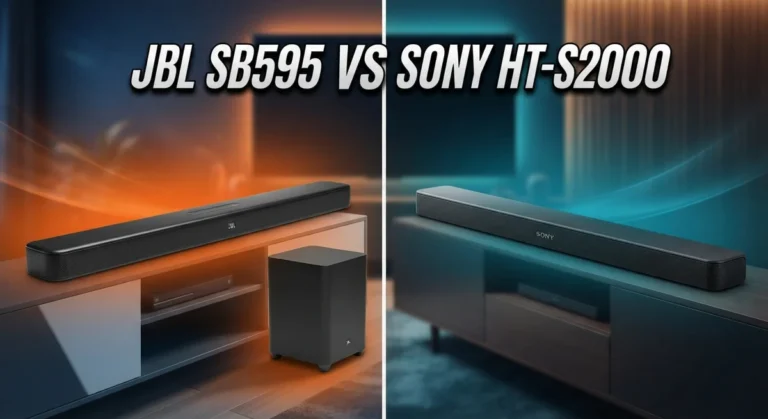

JBL SB595 vs Sonos Ray: Soundbar Comparison for Home Theater vs TV Watching
Choosing a soundbar can feel tricky. Two strong options stand out today: the JBL SB595 and the Sonos Ray.
Both promise to upgrade your TV audio. But they take very different paths to get there.
The JBL SB595 brings big power and true Dolby Atmos. It aims to fill your room with cinematic, immersive sound.
The Sonos Ray takes a simpler approach. It focuses on crisp dialogue and a compact design that fits smaller spaces.
So which one fits your setup? That depends on how you watch TV and what sound experience you want.
In this guide, we will compare specs, strengths, and weaknesses side by side. You will see how each soundbar handles movies, shows, and everyday viewing.
By the end, you will know exactly which soundbar matches your room and your listening habits. Let’s break down the JBL SB595 and Sonos Ray to help you decide.
Quick Comparison: JBL SB595 vs JBL Sonos Ray
| Feature | JBL SB595 | JBL Sonos Ray |
|---|---|---|
| Channels | 3.1.2 channel | 2 channel |
| Power Output | 440W | Not specified |
| Subwoofer | 6.5″ wireless included | Not included |
| Audio Format | True Dolby Atmos | No Atmos support |
| Connectivity | Wireless subwoofer link | Optical/WiFi |
| Special Features | Height channels for immersion | Dialogue enhancement, room correction |
| Ecosystem Integration | Standalone system | Sonos multi-room ecosystem |
| Ideal Use Case | Home theater cinematic audio | TV dialogue in small spaces |
JBL SB595 Review

- Bring the power: Fill your whole room with sound. An impressive 300W of total system power puts you in control...
- Surround yourself with sound: JBL Surround Sound instantly brings movies, sports and music to life. Upgrade to an...
- All about the bass: Why just listen to the bass when you can experience it. The 6.5’’ wireless subwoofer...

Last update on 2026-09-14 / Affiliate links / Images from Amazon Product Advertising API
The JBL SB595 is a premium 3.1.2 channel soundbar system built for serious home theater fans. It combines a main soundbar, wireless subwoofer, and height speakers to create an immersive surround sound experience.
This system delivers true Dolby Atmos support, which means sound moves around you in three dimensions. The 440W power output fills large rooms without breaking a sweat, and the warm, balanced audio profile works well for movies, shows, and music alike.
The build quality feels solid and substantial throughout. The 6.5″ wireless subwoofer adds deep bass without cluttering your space, while the height channels bring overhead effects to life during action scenes and dramatic moments.
In real-world use, the SB595 shines when you want cinematic audio that pulls you into the action. Setup is straightforward, and the system performs consistently across different content types.
Pros
- True Dolby Atmos with height channels for 3D sound
- Powerful 440W output handles large rooms easily
- Wireless subwoofer adds deep bass without cables
- Warm, balanced sound profile works for movies and music
Cons
- No DTS audio format support
- Operates as a standalone system, not part of a multi-room ecosystem
- Requires more wall space than compact soundbars
JBL Sonos Ray Review

- Experience clearer, more powerful sound than ever before possible by a small standalone soundbar.
- Dynamic sound that enhances the drama and creates a surprisingly wide soundstage.
- Zero-stress setup with only two cables and help from the Sonos app.
Last update on 2026-10-15 / Affiliate links / Images from Amazon Product Advertising API
The Sonos Ray is a compact 2-channel soundbar built for TV lovers who want crystal-clear dialogue without complexity. It pairs optical and WiFi connectivity to work seamlessly with your existing setup.
This soundbar shines for dialogue-focused content like news, talk shows, and dramas. The room correction feature (iOS only) adapts sound to your space, while dialogue enhancement mode pushes voices to the front for easy listening.
Build quality feels premium yet understated—slim enough to fit under most TVs. In real-world use, the Ray performs best in smaller to medium rooms where you sit closer to the screen.
The soundbar integrates smoothly with the Sonos ecosystem, letting you expand to multi-room audio later. TV remote sync means one control handles both picture and sound without extra buttons.
Pros
- Excellent dialogue clarity and voice reproduction for TV content
- Compact form factor fits tight spaces and small entertainment centers
- Integrates with Sonos multi-room system for future expansion
- Works with optical and WiFi, plus TV remote control sync
Cons
- No Dolby Atmos support limits immersive movie experiences
- Lacks low-bass response; no subwoofer included or available
- Limited to 2-channel audio, not surround sound
Head to Head: Key Differences
The JBL SB595 and Sonos Ray serve different listening needs, and understanding those differences helps you pick the right one.
Channel Configuration and Sound Depth
The SB595 delivers a full 3.1.2 channel setup with dedicated height speakers for Dolby Atmos. The Ray uses a simple 2-channel design without height channels or surround capabilities.
If you watch action movies and want sound that moves above you, the SB595 creates that immersive experience. The Ray keeps things straightforward for everyday TV watching.
Raw Power Output
The SB595 pumps out 440W of power from its main bar and wireless subwoofer combined. The Ray produces significantly less output from its compact bar alone.
Larger rooms benefit from the SB595’s muscle, while the Ray handles smaller spaces perfectly well.
Subwoofer Inclusion
The SB595 comes with a wireless subwoofer in the box, giving you deep bass immediately. The Ray has no subwoofer included, so low-frequency content stays limited.
Adding a subwoofer to the Ray later means extra expense and setup complexity.
Ecosystem Integration
The Ray connects seamlessly to other Sonos speakers for multi-room audio throughout your home. The SB595 operates as a standalone system without that ecosystem flexibility.
Sonos owners who want to expand their audio setup benefit from Ray’s compatibility.
Content Type Strengths
The SB595 excels with movies, games, and content that uses Dolby Atmos. The Ray shines with dialogue-heavy shows, news broadcasts, and sports where voice clarity matters most.
Your viewing habits should guide your choice here.
Which One Should You Buy
The JBL SB595 takes the win in this comparison. It brings true Dolby Atmos, dedicated height channels, and a powerful subwoofer to the table.
This combo creates a cinematic experience that fills larger rooms with immersive sound. It simply outperforms the Sonos Ray in raw home theater power.
The Sonos Ray still holds its own for specific needs. It focuses on clear dialogue and fits neatly into smaller spaces.
Best for each buyer – JBL SB595: Perfect for home theater enthusiasts who want immersive, powerful, and cinematic surround sound in larger rooms. – Sonos Ray: Ideal for TV viewers and Sonos ecosystem users who want clear dialogue and a compact soundbar for smaller spaces.
Frequently Asked Questions
Which soundbar handles movies better?
The JBL SB595 wins for movie lovers. It has Dolby Atmos with height channels, so sound moves around you in three dimensions.
The 440W power and wireless subwoofer deliver deep bass and room-filling audio. You get a true cinematic experience.
The Sonos Ray works fine for casual movie watching. It focuses on clear dialogue and balanced sound rather than immersion.
Smaller rooms suit it well.
Does the Sonos Ray work without extra speakers?
Yes, absolutely. The Sonos Ray comes complete and ready to use right out of the box.
No subwoofer or height speakers needed.
The JBL SB595 also works standalone. Both soundbars function independently without additional equipment.
Can I expand either system later?
The Sonos Ray integrates with Sonos multi-room audio. You can add more Sonos speakers throughout your home and control them together.
This ecosystem grows with your needs.
The JBL SB595 operates as a standalone unit. It doesn’t connect to a larger multi-room network.
Expansion isn’t really an option here.
Which soundbar fits small spaces?
The Sonos Ray is your choice for tight spaces. Its compact design fits under almost any TV without taking up much room.
Perfect for apartments and smaller entertainment centers.
The SB595 is larger due to its subwoofer and additional channels. It needs more physical space.
What if I mostly watch TV shows and news?
The Sonos Ray excels here. Its dialogue enhancement mode makes voices crystal clear for talk shows, news broadcasts, and dramas.
Clarity matters more than immersion for this content.
The SB595 handles it fine too, but it’s built for action movies and surround sound rather than dialogue focus.

Sili is a tech reviewer who cuts through the hype to find AI tools and gadgets that make life easier. She shares honest reviews and simple guides for everyday tech users.