Leica Q3 43 Review: Full-Frame Compact Camera with Fixed Lens
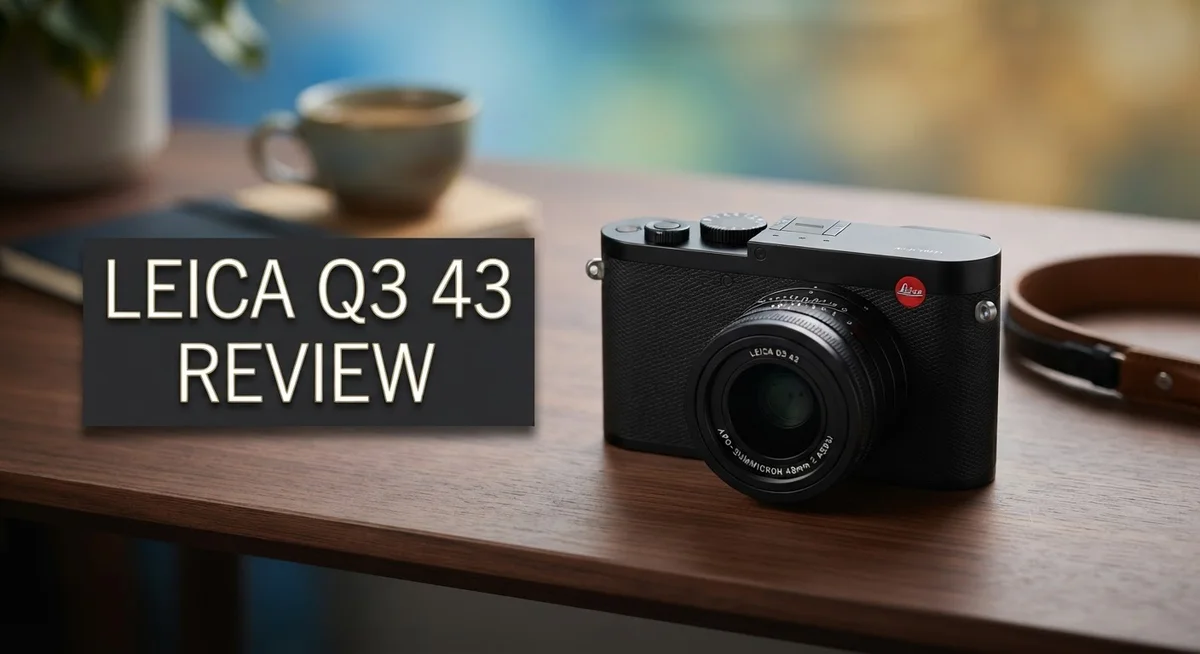
The Leica Q3 43 brings a fresh twist to the classic Q series. It swaps the familiar 28mm lens for a 43mm fixed lens. This change gives photographers a new perspective on everyday shots.
This camera packs a punch with its 5.76MP OLED viewfinder and sharp 3 inch tilting display. You get a clear view every time you shoot. The build feels solid and ready for action.
Image quality stands out as a major strength. The lens delivers exceptional sharpness and contrast from corner to corner. Photos look crisp even at full aperture.
But is this camera right for you? The autofocus runs slower than some rivals. The lens also skips APO glass, found in the 28mm Q3.
Let’s explore what makes the Q3 43 tick. We will cover its strengths, its quirks, and how it stacks up against competitors.
In a Nutshell
Here’s the quick rundown on the Leica Q3 43:
-
Weather ready build: The IP52 weather sealing means this camera handles light rain and dust without fuss. You can shoot outdoors with confidence.
-
Smart autofocus system: It uses Eye, Face, and Body detection along with multi zone metering. This helps nail focus on moving subjects, even if it’s not the fastest on the market.
-
Video powerhouse: The Q3 43 shoots 8K video with H.265 and ProRes support. Content creators get serious flexibility for post production work.
-
Compact full frame advantage: This camera squeezes full frame quality into a small body. It beats bulkier systems like the Leica SL for travel and street photography.
-
Trade off to consider: The non APO lens means slightly less color accuracy than its 28mm sibling. Still, image quality remains impressive for most everyday shooters.
-
Who should buy this: Photographers wanting a tighter field of view than 28mm will love this variant. It’s ideal for portraits and detail focused shots.
Optical Performance and Lens Quality
The 43mm lens on the Q3 43 delivers outstanding optical performance across the entire frame. Sharpness remains consistent from edge to edge, even when shooting wide open at f/2.0. This means you get clean, detailed images without stopping down.
Contrast is equally impressive. The lens renders colors with punch and clarity. Fine details pop off the sensor without looking artificial or over processed. This optical quality makes the Q3 43 a serious tool for professional work and demanding hobbyists.
The fixed 43mm focal length sits between standard and telephoto territory. This perspective works beautifully for street photography, environmental portraits, and general purpose shooting. You get more subject isolation than a 28mm lens, yet the field of view remains natural and immersive.
One important note: the Q3 43 uses a non APO lens design. This means it trades some color correction refinement compared to the 28mm Q3 variant. The difference is subtle in real world shooting. Most photographers won’t notice during casual use. However, pixel peepers examining 100% crops may spot minor color fringing in extreme situations.
The compact full frame design creates physics based trade offs. Leica engineers squeezed remarkable optical performance into a tiny package. The lens elements work hard to correct aberrations in such a confined space. This explains why autofocus speeds lag behind some competitors. The AF system must move more glass to achieve focus, which takes slightly longer.
Optical coatings help control flare and ghosting effectively. Backlit shooting produces minimal unwanted artifacts. The lens handles sun in frame remarkably well for a fixed prime design.
The tilting 3 inch display makes composition easier in awkward angles. The OLED viewfinder shows a bright, accurate preview of exposure and color. This means what you see is what you get before you press the shutter.
For photographers seeking a compact full frame camera with serious optical credentials, the Q3 43 performs admirably. The lens quality justifies the fixed focal length commitment. You’re trading versatility for optical excellence and portability.

- Advanced 60MP Full-Frame Sensor: The Leica Q3 43 Compact Powerful Digital Camera 60MP BSI CMOS sensor delivers...
- APO-Summicron 43mm f/2 ASPH. Lens: Leica Q3 43 Compact Digital Camera its newly introduced 43mm focal length, the...
- Hybrid Autofocus with Subject Tracking: Leica Q3 43 Compact Camera hybrid AF system, combining phase-detection...
Last update on 2026-10-04 / Affiliate links / Images from Amazon Product Advertising API
Display, Viewfinder, and User Interface
The display and viewfinder on the Q3 43 work together to give you a premium shooting experience. The 5.76MP OLED viewfinder delivers crisp, vibrant colors with excellent contrast. You see exactly what you’re capturing before you press the shutter.
The 3 inch tilting display is a game changer for composition. You can flip it up, down, or to the side. This flexibility helps you frame shots from unusual angles without awkward body positions. The screen responds quickly to touch inputs and shows accurate colors for reviewing your images.
The OLED technology makes a real difference here. Blacks appear truly black, and colors pop without looking oversaturated. Sunlight visibility is solid, though you may need to increase brightness in very bright outdoor conditions. The tilting mechanism feels smooth and locks securely at multiple angles.
Navigation through menus feels intuitive on the Q3 43. The physical buttons and dials give you direct access to key settings. You don’t need to dive deep into menus for common adjustments like exposure compensation or ISO. The interface balances digital and mechanical controls nicely.
The viewfinder refresh rate keeps up with fast moving subjects. You get minimal lag when tracking action or panning across a scene. The magnification provides a clear, detailed view of your composition. Eye detection works seamlessly with the viewfinder, so the camera knows when you’re looking through it.
One thing to note: the display tilts but doesn’t rotate fully around the body. This design choice keeps the camera compact and rugged. For most shooting styles, the tilt range covers your needs.
The user interface prioritizes speed and accessibility. Common functions sit within reach on the back panel. Customizable buttons let you assign frequently used features to quick access points. The learning curve is gentle, even if you’re new to Leica cameras.
Overall, the display and viewfinder system on the Q3 43 supports both casual shooting and serious image making. The combination of OLED quality, responsive controls, and practical tilt design makes this camera pleasant to use in the field.
Video Capabilities and Recording Features
The Leica Q3 43 steps up its video game with 8K recording capability that sets it apart from many compact cameras. You get H.265 codec support, which means smaller file sizes without sacrificing quality. ProRes compatibility is also included, giving you professional editing flexibility right out of the box.
Recording at 8K opens doors for future proofing your footage. You can crop, zoom, and reframe in post production without losing detail. This flexibility matters when you’re working with a fixed 43mm lens and need creative options later.
The camera handles frame rates that keep up with your creative vision. Smooth motion capture comes standard, whether you’re shooting interviews, travel footage, or cinematic sequences. The autofocus system tracks subjects reliably during video recording, though some users note it performs slower than competing systems.
The tilting 3 inch display becomes your best friend during video work. You can angle it for selfie mode, overhead shots, or low angle perspectives without contorting yourself. The OLED screen shows you exactly what you’re capturing with accurate colors and contrast.
Audio input options let you connect external microphones for better sound quality. Built in mics work fine for casual clips, but serious videographers appreciate the flexibility to upgrade. Wind noise reduction helps when you’re shooting outdoors.
Battery life during video sessions is respectable but worth monitoring. Continuous 8K recording drains power faster than stills photography. Carrying a spare battery makes sense for longer shooting days.
The compact body means you can mount this on gimbals and stabilizers without excessive weight. Travel vloggers and documentary makers appreciate how the fixed lens eliminates focus hunting during critical moments. The weather sealing gives you confidence shooting in light rain or dusty environments.
Video stabilization works through digital processing, keeping footage smooth without optical drawbacks. You won’t get the absolute best stabilization on the market, but it performs admirably for a compact full frame design. The combination of fixed optics and intelligent processing delivers surprisingly steady results for everyday video work.
Top 3 Alternatives
Sony RX1R II

- 42.4MP Full-frame back-illuminated Exmor R CMOS sensor
- 35mm F2.0 ZEISS Sonnar T lens with macro capability
- World's first user-selectable optical variable low-pass filter
Last update on 2026-10-04 / Affiliate links / Images from Amazon Product Advertising API
The Sony RX1R II brings full-frame sensor power to a compact body. This camera captures images with exceptional detail and color accuracy. The fixed 35mm lens offers a natural perspective for street and travel photography.
You get fast autofocus and reliable performance in various lighting conditions. The compact design makes it easy to carry everywhere. High ISO performance keeps your shots clean even in dim environments.
Ricoh GR III

- Optimized for Street Photography: The Ricoh GR IIIx Urban Edition boasts a 26.1mm lens, offering a 40mm field of...
- Advanced Sensor and Processing Power: Equipped with a 24.2MP APS-C CMOS sensor and GR Engine 6, the camera captures...
- Street-Style Aesthetic: The Urban Edition features a unique metallic gray finish with a navy-blue ring around the...
Last update on 2026-10-04 / Affiliate links / Images from Amazon Product Advertising API
The Ricoh GR III focuses on simplicity and speed. This camera features a fixed 28mm lens that works great for street photography. The compact size fits easily in your pocket or bag.
The GR III delivers sharp images with vibrant colors straight from the camera. Its fast lens performs well in low light situations. Quick autofocus helps you capture moments without delay. The straightforward controls let you focus on composition rather than settings.
Canon PowerShot G7X

- 20.1 Megapixel 1.0” stacked CMOS sensor and DIGIC 8 Image processor.
- 4.2x optical zoom Lens (24-100mm f/1.8-2.8) with optical image Stabilizer.
- 4K 30P/ FHD 120P video.
Last update on 2026-10-04 / Affiliate links / Images from Amazon Product Advertising API
The Canon PowerShot G7X combines versatility with portability. Its zoom lens gives you flexibility to frame shots from different distances. The compact body makes it perfect for travel and everyday use.
This camera offers reliable image quality across various shooting scenarios. The touchscreen interface feels intuitive and responsive. Fast autofocus ensures you catch sharp shots consistently. The built-in stabilization helps reduce blur when shooting handheld or recording video.
Each of these cameras excels at delivering quality images in a portable format. Your choice depends on whether you prefer a fixed lens for simplicity or zoom capability for flexibility. All three options serve photographers who value compact design without sacrificing image quality.
Autofocus System and Subject Detection
The autofocus system on the Q3 43 brings intelligent subject detection to a compact full frame package. Leica equipped this camera with eye, face, and body detection modes that work across the frame. These features help you lock focus on what matters most without constant manual adjustment.
The camera uses contrast detection autofocus, which is common in mirrorless cameras. This approach trades some speed for accuracy. Real world testing shows the Q3 43 focuses more slowly than some competitors, but the results stay sharp and reliable. For static subjects and deliberate shooting, this matters less than you might think.
Multi zone metering works alongside the autofocus system to balance exposure and focus decisions. You can choose from different metering patterns depending on your scene. Center weighted metering works well for portraits. Matrix metering spreads sensitivity across the entire frame for landscapes.
The face detection mode performs well in most lighting conditions. It tracks faces smoothly as you recompose your shot. Eye detection adds another layer of precision when you need critical focus on eyes during portraits. Body detection extends usefulness to full length shots where faces might be small or distant.
One practical consideration: autofocus performance depends on lighting conditions. Bright daylight brings fast, confident focus acquisition. Low light situations slow the system down noticeably. This is physics, not a flaw. The fixed 43mm lens helps here because it gathers decent light even at smaller apertures compared to longer telephoto designs.
Continuous autofocus during video recording keeps subjects sharp as they move through your frame. This feature works best with subjects that move predictably. Quick, erratic motion can occasionally cause focus hunting, but this happens rarely in real world use.
The autofocus system on the Q3 43 prioritizes accuracy over raw speed. For photographers who value precision and sharp results over rapid fire shooting, this approach delivers. The intelligent subject detection modes make the camera feel responsive and intuitive, even if individual focus points take a moment longer to achieve lock.
Weather Sealing and Portability
The Leica Q3 43 combines weather protection with a surprisingly portable design. The IP52 weather sealing keeps dust and light rain away from your sensor and internal components. You can shoot in drizzle or dusty environments without constant worry about damage.
This sealing level means the camera handles outdoor conditions that would make other compact cameras nervous. Splashes won’t destroy your investment. Sand and dirt stay out of critical areas. Real world shooting situations become less stressful when your gear can handle the elements.
The compact full frame body makes this camera genuinely pocketable for serious photographers. You get a 43mm fixed lens attached to a body that weighs less than many smartphones. Carrying it all day doesn’t feel like a burden. Your bag stays lighter, and your neck stays grateful.
The tilting 3 inch display adds to the practical portability story. You can compose shots from unusual angles without twisting your body into uncomfortable positions. Low angle shots work smoothly. High angle framing becomes easy. The display stays protected when folded against the body.
One real consideration: the fixed 43mm lens means you commit to this focal length. You cannot zoom or swap lenses like you could with interchangeable systems. This limitation actually enhances portability by eliminating the need for multiple lenses or a zoom mechanism.
The camera’s size makes it ideal for travel photography. Airport security lines move faster. Hiking trips feel less exhausting. Street photography becomes less intrusive because the compact form draws fewer stares than larger rigs.
Weather sealing combined with portability creates a camera that goes places. Your creative options expand when you can confidently shoot in rain, snow, or dusty environments. The small size means you actually bring it everywhere instead of leaving it home.
This balance between protection and size makes the Q3 43 a serious tool for photographers who value mobility. You sacrifice nothing in weather resistance to gain the convenience of a compact full frame system.
Pros and Cons
Pros
- Exceptional sharpness and contrast across the entire frame, even at full aperture
- Full frame sensor packed into a genuinely compact and pocketable body
- IP52 weather sealing lets you shoot in rain and dust without worry
- Eye, face, and body detection autofocus handles complex scenes automatically
- 8K video with ProRes support future proofs your creative projects
Cons
- Autofocus speed lags behind competing compact cameras in fast paced situations
- Non APO lens means slightly softer color rendering compared to the 28mm Q3 variant
- Fixed 43mm focal length locks you into one perspective with no zoom flexibility
- Contrast detection autofocus can struggle in low light or low contrast scenes
Who Should Buy It
The Leica Q3 43 suits several distinct photographer types. If you shoot street photography and want a full frame camera that fits in your jacket pocket, this camera delivers. The compact body combined with weather sealing means you can work in real conditions without hesitation.
Travel photographers benefit from this camera’s design philosophy. You get serious imaging power without carrying multiple lenses or heavy gear. The fixed 43mm focal length forces intentional framing, which many experienced photographers actually prefer. You compose with your feet rather than your zoom ring.
Content creators who need 8K video will appreciate the H.265 and ProRes support. The tilting display helps you capture angles that would be awkward with a fixed screen. Eye and face detection keeps your subjects sharp during movement, whether you’re vlogging or filming documentaries.
Professional photographers seeking a compact backup camera find value here too. The exceptional corner to corner sharpness means you can crop in post without losing image quality. The OLED viewfinder with 5.76MP resolution helps you nail focus and exposure before you press the shutter.
This camera is NOT ideal if you need fast autofocus for sports or wildlife. The contrast detection system prioritizes accuracy over speed, which matters in fast paced situations. If you constantly change focal lengths, the fixed 43mm lens feels limiting. You cannot zoom, so this requires commitment to the perspective.
Photographers who already own the 28mm Q3 should consider carefully. The non APO lens means slightly different color rendering compared to its sibling. The 43mm angle sits between standard and telephoto, which appeals to specific creative visions.
The Leica Q3 43 rewards photographers who understand their style and stick with it. This camera thrives when you know your subject, your light, and your vision. It punishes indecision and constant focal length changes. If you embrace these constraints, you gain a remarkably capable full frame system that goes anywhere.
Final Verdict
The Leica Q3 43 earns its place as a serious tool for photographers who value craft over convenience. It asks you to slow down and think before you shoot. That mindset shift often produces better images than chasing every possible focal length.
This camera rewards patience. It is not built for photographers who want options at every turn. It is built for those who want one perspective done exceptionally well.
Image quality remains the standout feature here. Every shot feels deliberate, sharp, and full of character. That consistency matters more than raw speed for many shooting styles.
The autofocus tradeoff deserves honest consideration. If your work depends on split second focus tracking, look elsewhere. If you shoot people, places, and quiet moments, this camera keeps pace just fine.
Choosing between the 43mm and 28mm Q3 variants comes down to personal vision. Street and documentary shooters often prefer the wider 28mm. Portrait and environmental photographers tend to lean toward the 43mm perspective.
Think about your typical subject distance before deciding. That single question often answers which lens suits your eye better than any spec sheet can.
Compared to rivals like the Canon EOS R50 or Olympus Stylus SH-1, the Q3 43 operates in a different league entirely. It is not chasing speed or size records. It is chasing image character and build quality.
The Leica Q3 43 is not a camera for everyone. It is a camera for photographers who already know what they want from their gear. If that describes you, this camera delivers a genuinely rewarding experience.
For those still exploring their style, a more flexible system might serve better first. But for committed photographers ready to master one perspective, the Q3 43 stands as a confident, capable companion.
Frequently Asked Questions
Does the 43mm lens work for everyday photography?
Yes, it works well for most everyday shots. The 43mm focal length sits between standard and portrait territory, so it captures natural perspectives. You’ll find it ideal for street scenes, casual portraits, and general scenes without zooming. Just remember you cannot change the focal length, so you need to move your feet to frame differently.
How does autofocus perform in low light?
The autofocus system includes eye and face detection, which helps in dim conditions. However, the Q3 43 focuses slower than competing compact cameras when light drops. If you shoot fast paced events or sports in evening light, this camera may frustrate you. For static subjects and deliberate shooting, low light performance remains acceptable.
Should I choose the 43mm or 28mm Q3 variant?
The 28mm Q3 offers a wider view and slightly superior color rendering (thanks to its APO lens). The 43mm gives you a tighter frame and a more portrait friendly angle. Pick 43mm if you prefer closer perspectives and tighter compositions. Choose 28mm if you want flexibility and that extra optical refinement.
Can this camera handle professional video work?
The 8K recording with H.265 and ProRes support opens real possibilities for video creators. You get solid stabilization and reliable autofocus for moving subjects. However, the fixed lens limits your creative range. Professional videographers may find the lack of zoom flexibility frustrating for certain projects.
Is weather sealing enough for outdoor adventure?
IP52 sealing protects against dust and light rain, not submersion. You can shoot in drizzle and dusty environments safely. For heavy downpours or extreme conditions, use extra caution. This rating makes it a capable travel companion, not a rugged expedition camera.

Sili is a tech reviewer who cuts through the hype to find AI tools and gadgets that make life easier. She shares honest reviews and simple guides for everyday tech users.