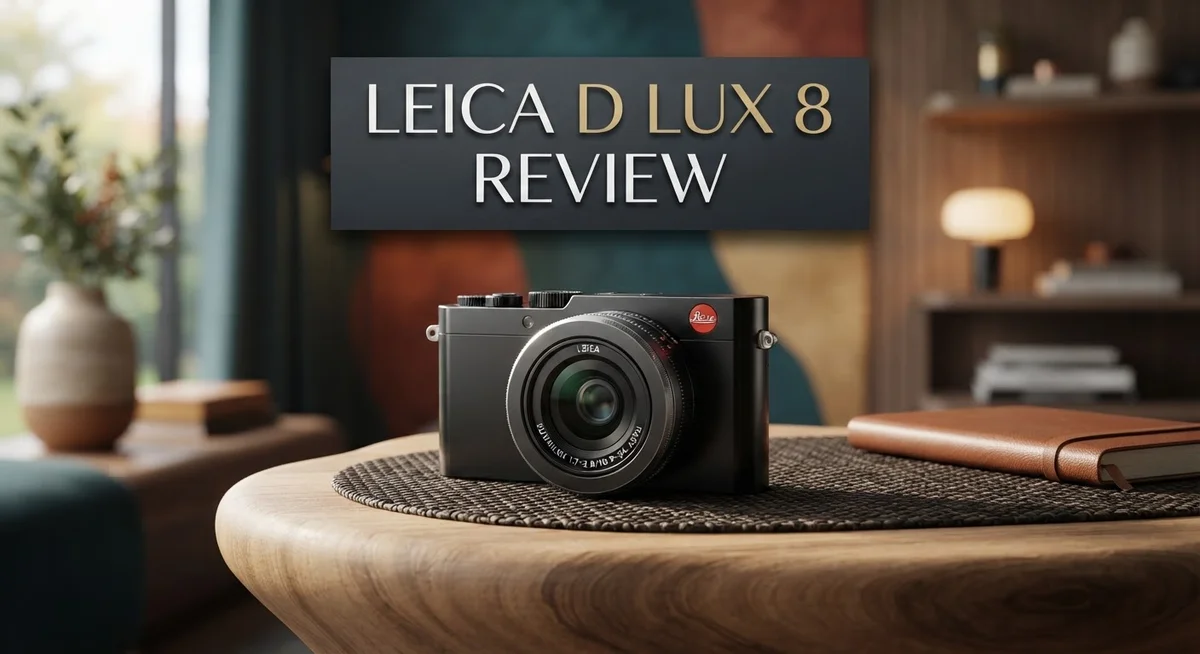
Leica D-Lux 8 Review: Premium Compact Camera Worth Buying?
Looking for a camera that feels fun and simple to use? The Leica D Lux 8 might be your answer.
This compact camera packs a punch. It carries a Summilux zoom lens with a 24-75mm equivalent range. That means you get sharp, beautiful images in many situations.
Leica built this camera with simplified menus and thoughtful design. You won’t feel lost in settings. Instead, you can focus on capturing great shots.
The D Lux 8 also offers a 13-stop dynamic range. This lets you capture detail in both bright and dark areas. Plus, it supports RAW and JPG formats, giving you flexibility in editing.
Is this little powerhouse right for you? Let’s explore its strengths and weaknesses together. You might find your next favorite travel companion.
In a Nutshell
Here’s the quick rundown on the Leica D Lux 8:
- Leica glass makes a difference. The Summilux zoom lens delivers sharp, vibrant images every time.
- RAW and JPG support gives you flexibility. You get creative control right out of the camera.
- Build quality stands out. The camera feels solid and premium in your hands.
- This camera trades pixel count for simplicity. You get fewer megapixels than older Leica models.
- Focus stacking is missing here. The Panasonic LX100 II offers this feature instead.
- Sensor size is smaller than some rivals. This affects low light performance slightly.
- Lightroom integration makes editing smooth. Your workflow stays fast and simple.
- Portability wins big points. You can slip this camera into a jacket pocket easily.
- User opinions vary on this model. Some love it, others expect more for what they get.
- Compared to the Fujifilm X100V or Leica Q3, this camera focuses on fun over features.
If you want a pocket friendly camera with Leica quality, this one delivers. Just know its limits before you decide.
Optical Quality and Lens Performance
The Summilux zoom lens is the star of this camera. It covers 24-75mm equivalent focal length, which gives you real flexibility for everyday shooting. You get wide angles for landscapes and decent reach for portraits without changing lenses.
Sharpness across the frame is impressive. The Leica optics deliver crisp details from edge to edge, even at wider apertures. Colors pop naturally without oversaturation. Contrast remains high in both bright and dim conditions.
The lens performs well in low light situations. You can shoot at f/1.7 to f/2.8 depending on zoom position. This means you capture more light and keep ISO lower than you’d expect. Night photography becomes genuinely enjoyable with this camera.
Chromatic aberration is minimal. You won’t see ugly purple or green fringing around high contrast edges. This speaks to the quality of Leica’s optical engineering. The coating on the glass elements really shows its value here.
Autofocus speed is snappy and reliable. The camera locks onto subjects quickly in most lighting. Continuous autofocus works smoothly for video too. You rarely miss the shot because the camera was slow to focus.
Optical stabilization helps when you’re shooting handheld. You can use slower shutter speeds without blur, especially useful in dim rooms or outdoors at dusk. This feature matters more on a compact camera where you can’t always use a tripod.
Distortion control is excellent. Straight lines stay straight, whether you’re shooting architecture or landscapes. Wide angle shots don’t have that barrel or pincushion effect that ruins otherwise good photos.
The zoom range itself is practical for most situations. It’s not ultra wide like some competitors, but it covers the lenses most people actually use. You won’t feel limited by the 24-75mm coverage in daily photography.
Color rendering through this lens is warm and pleasant. Skin tones look natural. Foliage appears vibrant. The Leica glass imparts a signature look that many photographers love.
Overall, the optical quality punches well above what you’d expect from such a compact camera. The lens is the real reason to consider this model.

- 17MP Four Thirds CMOS Sensor: Delivers high-quality images and 4K video with a fixed 10.9-34mm f/1.7-2.8 lens...
- Enhanced Viewing: Features a 3.0" 1.84m-dot TFT LCD and a 2.36MP OLED electronic viewfinder with automatic eye...
- Compact and Durable Design: Constructed from die-cast magnesium for lightweight yet robust handling and extended...
Last update on 2026-10-04 / Affiliate links / Images from Amazon Product Advertising API
Design, Build Quality, and Portability
The Leica D Lux 8 feels like a camera built for photographers who travel light. Its pocket-sized form factor makes it easy to slip into a jacket or bag without thinking twice. You won’t feel weighed down during long days of shooting.
The build quality impresses immediately. The camera feels solid and premium when you hold it. Materials are carefully chosen to balance durability with low weight. Every button and dial sits exactly where your fingers expect them. The grip provides comfort even during extended shooting sessions.
Portability is genuinely one of this camera’s biggest strengths. At its compact size, the D Lux 8 outperforms larger competitors when you need something you’ll actually carry. Professional photographers and casual users alike appreciate how it fits into everyday life. You can keep it ready without it becoming a burden.
The design philosophy here centers on simplification and ease of use. Leica stripped away unnecessary complexity. Menus are straightforward. Controls respond intuitively. This approach means you spend less time hunting through settings and more time capturing moments.
The body construction uses quality materials that withstand regular use. Seals protect against dust and moisture to a reasonable degree. The camera doesn’t feel fragile, even though it’s lightweight. You can confidently take it on adventures without constant worry.
One trade-off exists with this compact design. The smaller sensor sits at the heart of the D Lux 8, and it’s noticeably smaller than competitors like the Fujifilm X100V. This choice allowed Leica to maintain the pocket-friendly size while still delivering strong image quality. Some photographers view this as a fair compromise. Others might want more sensor real estate.
The handling experience stands out as genuinely enjoyable. The camera encourages you to shoot more because it’s so pleasant to use. Weight distribution is excellent. The controls feel natural under your fingers.
Portability wins big points here. If you want a camera that goes everywhere and feels great in your hands, the D Lux 8 delivers. Its thoughtful design makes it a genuine pleasure to carry and use daily. The compact form never sacrifices the premium feel Leica is known for.
Image Sensor and Dynamic Range
The sensor inside the D Lux 8 is smaller than what you’ll find in full-frame competitors. This is a deliberate choice. Leica prioritized portability and lens quality over maximum sensor size.
The camera captures images with 13 stops of dynamic range. This means you get excellent detail in both bright skies and dark shadows. You won’t lose information in extreme lighting situations as easily as with other compact cameras.
What makes this sensor interesting is how it handles color. The sensor produces warm, natural tones straight from the camera. Skin tones look accurate without excessive processing. Reds and oranges pop without looking artificial or oversaturated.
The smaller sensor does mean fewer total pixels compared to earlier Leica models. However, this isn’t necessarily a weakness. The pixels you do get are high quality. They work beautifully with the Summilux lens to create sharp, detailed images.
RAW capture gives you complete control in post-production. You can recover shadow details and adjust highlights with flexibility. JPG files also look excellent right out of the camera, so you don’t always need to edit.
Low light performance is solid. The sensor pairs well with the f/1.7 to f/2.8 lens aperture. You can shoot in dim conditions without pushing ISO too high. Noise stays under control even at higher sensitivities.
The dynamic range really shines during mixed lighting. Think sunset scenes or indoor shots with windows. The sensor captures both the lit areas and shadow details without harsh transitions. This gives you more options when you’re editing later.
One thing to note: the sensor size means depth of field behaves differently than larger sensors. You won’t get extreme background blur as easily. This actually works well for travel and street photography where you want more of the scene in focus.
The combination of this sensor with the Leica lens creates a specific character. Images have a consistent look that many photographers find appealing. It’s not about maximum specs. It’s about practical performance and image quality that serves your photography.
Top 3 Alternatives
Canon PowerShot G7X

- Canon USA Authorized. Items Include: Canon PowerShot G7 X Mark III Digital Camera (Black), NB-13L Battery Pack...
- Crisp Photos in a Compact Package - The PowerShot G7 X Mark III is built for sharp, vibrant photos without the bulk...
- 4K Video Made Simple - Shoot stunning 4K UHD video with no cropping, perfect for YouTube, vlogs, or home videos...
Last update on 2026-10-04 / Affiliate links / Images from Amazon Product Advertising API
The Canon PowerShot G7X offers excellent image quality for compact camera users. This camera delivers sharp photos in various lighting conditions. The 1-inch sensor captures fine details with vibrant colors.
You get a fast f/1.8-2.8 lens that works well for low-light photography. The compact design fits easily in your pocket or bag. The touchscreen interface makes navigation simple and intuitive. Video recording reaches 1080p resolution, which suits casual filmmakers.
Sony RX100 VII

- 20. 1MP 1. 0 Type stacked CMOS sensor, Zeiss Vario Sonnar T 24 200 millimeter F2. 8 F4. 5 large aperture high...
- 0. 02 sec. High AF speed, 357 point focal plane Phase detection AF and 425 point contrast detection AF
- Up to 20 fps blackout free shooting, using up to 60 times/sec. AF/AE calculations. Diopter Adjustment: -4.0 to...

Last update on 2026-10-04 / Affiliate links / Images from Amazon Product Advertising API
Sony’s RX100 VII stands out with its powerful zoom capabilities. The camera features a 24-200mm equivalent lens, giving you flexibility for different scenes. The 1-inch Exmor RS sensor produces clean images even at higher ISO settings.
Fast autofocus performance helps you capture moving subjects quickly. The camera shoots 4K video at 24p and 30p frame rates. The articulating screen lets you shoot from creative angles. Real-time eye autofocus tracks people’s faces accurately during video recording.
Panasonic Lumix LX10

- POINT-AND-SHOOT CAMERA: Large, 1-inch 20.1-megapixel MOS sensor plus 3X zoom LEICA DC VARIO-SU millimeter ILUX lens...
- TILTING SELFIE DISPLAY: Rear touch-enabled 3-inch LCD display (1040K dots) tilts upward 180 degrees for easy selfie...
- 4K VIDEO CAPTURE: 4K QFHD video recording (3840 x 2160), plus exclusive LUMIX 4K PHOTO and 4K Post Focus with...
Last update on 2026-10-04 / Affiliate links / Images from Amazon Product Advertising API
The Panasonic Lumix LX10 combines portability with solid performance. This camera features a 24-72mm equivalent lens and a 1-inch MOS sensor. The fast f/1.4-2.8 aperture performs admirably in dim environments.
Compact size makes it ideal for travel and everyday use. The camera offers 4K video recording capabilities for modern content creators. The fixed lens design keeps the camera lightweight and durable. Manual control options appeal to photographers who want creative input.
Handling, Controls, and User Interface
The Leica D Lux 8 puts intuitive controls right where your fingers expect them. The button layout follows a logical pattern that photographers understand instantly.
The mode dial sits on top of the camera body. You rotate it to switch between shooting modes. The dial clicks firmly into place. Each mode feels distinct and intentional.
The rear of the camera houses the main controls. The four-way navigation pad lets you move through menus smoothly. The OK button sits in the center. Menu diving feels natural, not frustrating.
The menu system deserves special praise. Leica kept things simple here. You won’t get lost hunting for obscure settings buried three layers deep. Common adjustments live on the first page. Advanced options exist but don’t clutter the experience.
The shutter button has excellent tactile feedback. It releases smoothly without lag. Half-press focuses your subject. Full press captures the shot. The feel matches what experienced photographers expect.
The zoom ring rotates around the lens barrel. It moves with gentle resistance. You can zoom smoothly or make quick jumps. The range from 24mm to 75mm covers most everyday situations.
The grip on the right side feels substantial. Your hand sits naturally on the camera. The rubberized surface prevents slipping. Even with wet hands, control remains secure.
The LCD screen flips up and rotates. This flexibility helps you shoot from unusual angles. The screen itself shows information clearly. Brightness adjusts automatically in sunlight.
The focus mode selector lets you switch between autofocus and manual focus. The switch moves easily without accidental changes. Manual focus works smoothly with the focus ring.
The exposure compensation dial sits near the shutter button. You adjust exposure without diving into menus. Quick adjustments happen in seconds.
Overall, handling feels effortless. The camera doesn’t fight you. Every control sits exactly where it should. The design philosophy emphasizes simplicity over complexity. You spend less time fumbling with buttons and more time composing shots. Whether you’re a beginner or seasoned photographer, the D Lux 8 feels approachable and responsive.
RAW Processing and Software Integration
The D Lux 8 shoots RAW files alongside JPEGs, giving you flexibility in post-production. This dual format approach means you capture the full sensor data while also getting processed JPEGs straight out of the camera.
RAW files from this camera contain all 13 stops of dynamic range information. You can recover shadow and highlight detail that would be lost in JPEGs alone. This becomes especially useful during mixed lighting situations where you need maximum editing control.
Adobe Lightroom integrates smoothly with the D Lux 8’s RAW files. The software recognizes the camera’s color science and applies appropriate profiles automatically. You’ll find editing workflows feel natural when working with these files in Lightroom’s interface.
The camera’s smaller sensor produces RAW files that are more manageable than full-frame alternatives. File sizes stay reasonable, making storage and backup less demanding. Processing speed improves when you’re working with these files on standard computers.
One limitation worth mentioning: the D Lux 8 lacks advanced in-camera processing features like focus stacking. You won’t find automated HDR merging or computational photography tools built into the camera itself. This means some post-processing tasks require external software that competitors might handle internally.
Leica’s JPEG processing deserves attention here. The camera’s built-in color rendering is excellent, so many photographers find the JPEGs usable without editing. This is particularly handy when you want quick results without opening editing software.
The RAW files respond well to standard editing techniques. Exposure adjustments, white balance corrections, and color grading all feel intuitive. The dynamic range allows significant latitude before you encounter quality degradation.
File organization becomes easier thanks to the camera’s straightforward naming system. Metadata embeds properly into RAW files, so you maintain complete information about each shot. This matters when you’re sorting through hundreds of images from a trip.
Overall, the D Lux 8’s RAW and software integration keeps things practical. You get professional-grade RAW capture without overwhelming complexity. The camera pairs well with standard editing workflows, making it accessible to photographers of all skill levels.
Pros and Cons
Pros
- High quality Leica optics deliver sharp, vibrant images with excellent color rendition
- Compact pocket sized design makes it easy to carry everywhere you go
- Intuitive menu system and simplified controls let you focus on shooting instead of fiddling with settings
- Excellent build quality and handling feel premium and reliable
- Fun and engaging to use with responsive autofocus and quick performance
Cons
- Smaller sensor means fewer total pixels than earlier Leica models and some competitors
- Limited in camera features compared to alternatives like the Panasonic LX100 II, missing focus stacking capability
- Depth of field behavior differs from larger sensor cameras, which takes adjustment time
- Mixed user sentiment exists around overall value proposition relative to other compact cameras on the market
Who Should Buy It
The D Lux 8 appeals to photographers who want a serious camera without the size and complexity of interchangeable lens systems. Travel photographers love this camera. You get professional image quality in a pocket sized package. The lightweight design means you’ll actually carry it everywhere, not leave it at home.
Content creators benefit from the flip out LCD screen. Vlogging, streaming, and social media work become easier when you can compose from any angle. The responsive autofocus keeps moving subjects sharp.
Street photographers appreciate the fixed lens approach. You learn composition faster when you can’t swap lenses. The 24 75mm equivalent range covers most everyday situations. The compact form factor lets you blend into crowds instead of announcing yourself with a large camera.
Leica enthusiasts find value here. You get genuine Leica optics and the brand’s image signature. The simplified menu system respects your intelligence and lets you focus on creative decisions rather than menu diving.
Professional photographers use the D Lux 8 as a backup or secondary camera. RAW support with 13 stops of dynamic range gives you real editing flexibility. The Adobe Lightroom integration streamlines your workflow. You can deliver client work from this camera without hesitation.
Casual photographers who want to step beyond smartphones choose this camera. The controls feel natural. The image quality jumps noticeably above phone cameras. You won’t feel overwhelmed by unnecessary features.
However, the D Lux 8 might disappoint you if you need extensive in camera processing tools. Focus stacking and advanced computational photography are absent. You handle that work in post production instead.
Skip this camera if you shoot primarily telephoto or ultra wide angles. The fixed zoom range won’t suit those needs.
Consider alternatives if you require maximum megapixels or extensive manual controls. The smaller sensor means fewer total pixels than some competitors.
The D Lux 8 suits people who value simplicity, portability, and optical quality above everything else. If that describes your photography style, this camera deserves serious consideration.
Final Verdict
The Leica D Lux 8 earns its place as a thoughtful compact camera for photographers who value simplicity. It blends classic Leica styling with modern features that feel natural to use.
This camera suits people who want a break from complicated menus and endless settings. It brings joy back to photography by keeping things simple and direct.
Street photographers and travelers will likely enjoy this camera the most. Its fixed lens and pocket friendly size make it a natural companion for everyday adventures.
If you already own Leica gear, this camera fits right into your collection. It shares the same image quality and shooting feel as larger Leica models, just in a smaller package.
Who should consider skipping this camera? Sports shooters and wildlife photographers may find the fixed lens range too limiting. Anyone who relies heavily on telephoto reach should look elsewhere.
People who need advanced computational photography features might also feel underwhelmed. The camera keeps things straightforward, which means it skips some modern conveniences found in rival models.
That said, most casual and enthusiast photographers will appreciate what this camera offers. It rewards patience and skill rather than relying on automated tricks.
The D Lux 8 works best as a tool for people who enjoy the process of taking photos. It encourages you to slow down and think about composition.
Overall, this camera delivers a satisfying blend of classic design and modern usability. It stays true to Leica’s reputation for quality while remaining approachable for newer photographers.
If you want a camera that feels special to hold and use, this one delivers. It turns ordinary moments into memorable shots without overwhelming you with options.
In short, the D Lux 8 earns a solid recommendation for anyone who wants genuine Leica character in a compact, everyday camera.
Frequently Asked Questions
Does the D Lux 8 have autofocus and how fast is it?
Yes, the D Lux 8 features responsive autofocus that works quickly and reliably. The camera locks onto subjects without delay, making it easy to capture moments as they happen. You won’t experience frustrating lag or missed shots due to slow focusing.
Can I shoot in RAW format with this camera?
Absolutely. The D Lux 8 supports both RAW and JPG formats simultaneously. This means you get maximum flexibility in post processing. RAW files give you full control over exposure, color, and detail recovery in software like Adobe Lightroom.
What is the dynamic range capability of the D Lux 8?
The camera delivers a 13 stop dynamic range. This allows you to capture detail in both bright highlights and dark shadows within a single shot. You’ll retain more information in challenging lighting situations, which is particularly useful for street photography and travel.
How does the D Lux 8 compare to the Panasonic LX100 II?
The Panasonic LX100 II offers more in camera software features, including focus stacking capability. However, the D Lux 8 emphasizes simplicity and genuine Leica optics. The D Lux 8 feels more streamlined if you prefer straightforward controls and plan to edit photos on your computer afterward rather than relying on built in processing tools.
Is this camera good for travel and street photography?
Yes, the compact pocket sized form factor makes it ideal for both uses. The fixed 24 75mm equivalent lens covers most everyday shooting scenarios. Lightweight and portable design means you’ll actually carry it everywhere, which is when you capture your best photos.

Sili is a tech reviewer who cuts through the hype to find AI tools and gadgets that make life easier. She shares honest reviews and simple guides for everyday tech users.