JBL SB595 vs Samsung HW-Q600C: Dolby Atmos vs DTS:X Soundbar Comparison
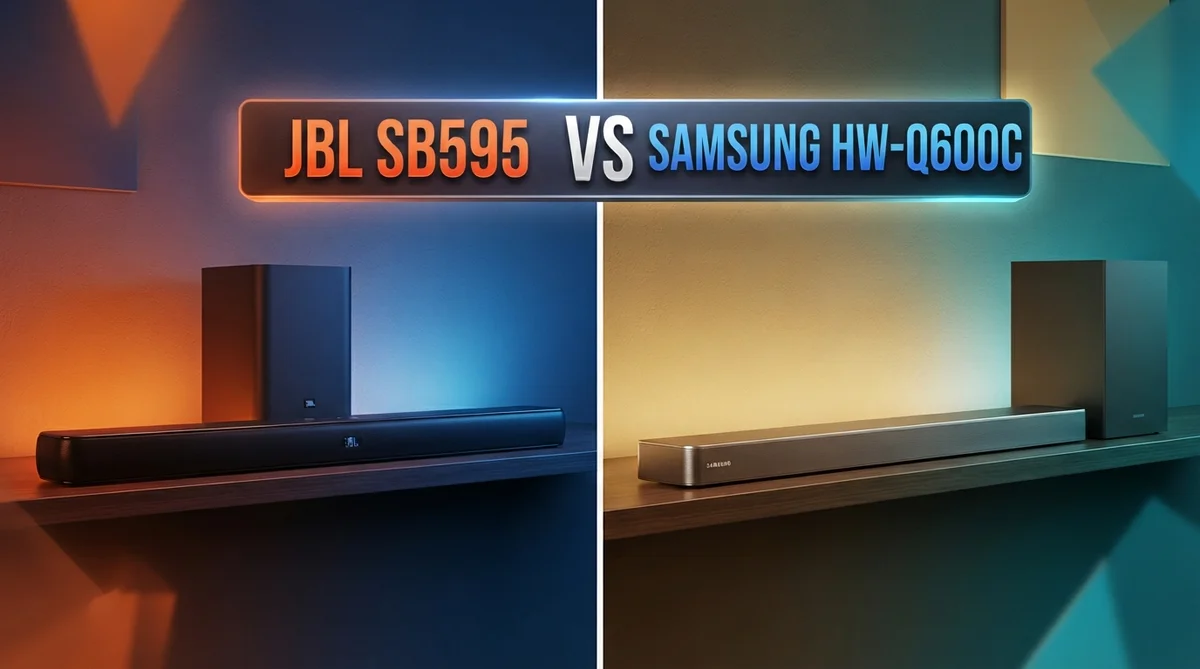
Choosing a soundbar can feel tricky. Two strong options stand out today: the JBL SB595 and the Samsung HW-Q600C.
Both models bring 3.1.2 channel setups and Dolby Atmos support to your living room. But they take different paths to deliver great sound.
The JBL SB595 focuses on pure Atmos performance. It offers warm, clear audio that movie lovers will enjoy.
The Samsung HW-Q600C adds DTS:X support and gaming features. It gives you more flexibility for different content types.
This guide breaks down specs, strengths, and weaknesses for each soundbar. You will see how they perform with movies, music, and games.
By the end, you will know which soundbar fits your setup best. Let’s compare these two options side by side.
Quick Comparison: JBL SB595 vs Samsung HW-Q600C
| Feature | JBL SB595 | Samsung HW-Q600C |
|---|---|---|
| Channels | 3.1.2 channels | 3.1.2 channels |
| Power Output | 440W | Not specified |
| Codec Support | Dolby Atmos only | Dolby Atmos + DTS:X |
| Subwoofer | 6.5″ wireless subwoofer | Wireless subwoofer, weak mid-bass |
| Key Technology | Pure Atmos approach | Acoustic Beam, Q-Symphony |
| Sound Profile | Warm, balanced, clear | Movie/gaming optimized |
| Gaming Features | Not specified | Game Mode Pro |
| Best Use Case | Movie Atmos accuracy | Gaming and multi-format content |
JBL SB595 Review

- Bring the power: Fill your whole room with sound. An impressive 300W of total system power puts you in control...
- Surround yourself with sound: JBL Surround Sound instantly brings movies, sports and music to life. Upgrade to an...
- All about the bass: Why just listen to the bass when you can experience it. The 6.5’’ wireless subwoofer...

Last update on 2026-09-14 / Affiliate links / Images from Amazon Product Advertising API
The JBL SB595 is a 3.1.2 channel soundbar built for viewers who demand authentic Dolby Atmos performance. It delivers 440W of power and pairs with a 6.5″ wireless subwoofer to fill your room with immersive sound.
This soundbar shines when playing movies and shows that use Atmos encoding. The balanced warm sound signature makes dialogue pop without harshness, and the system handles high volumes without distortion.
Build quality feels solid throughout, with sturdy connections and a reliable wireless subwoofer link. Real-world performance proves excellent for streaming services and disc-based content that supports Atmos.
The JBL focuses on audio purity rather than gaming tricks or multiple codec support. If you prioritize 3D audio clarity and Atmos accuracy, this soundbar delivers exactly that.
Pros
- True Dolby Atmos support with excellent 3D audio imaging
- Warm, balanced sound profile that handles dialogue with clarity
- High volume output without distortion
- Solid wireless subwoofer integration at 6.5″
Cons
- No DTS:X codec support (only Dolby formats)
- Subwoofer adequate but not ideal for bass-heavy music lovers
Samsung HW-Q600C Review

- Q-SYMPHONY: Amp up your audio with the greatest duo of all time—Samsung TVs paired with Samsung soundbars; With...
- 3.1.2 CH TRUE DOLBY ATMOS SOUND: There’s more that meets the ear; Appreciate the story, concert or soundtrack on...
- ADAPTIVE SOUND: Sick of missing lines? Hear voices better, even at low volume, with intelligently optimized audio...
Last update on 2026-10-15 / Affiliate links / Images from Amazon Product Advertising API
The Samsung HW-Q600C is a 3.1.2 channel soundbar that brings gaming and movie flexibility to your setup. It handles both Dolby Atmos and DTS:X formats, giving you codec options the JBL SB595 cannot match.
This soundbar uses Acoustic Beam technology to direct sound toward your ears with precision. The built-in graphic EQ lets you fine-tune the sound to your room, and Game Mode Pro reduces input lag for faster response during gameplay.
Setup feels straightforward thanks to Q-Symphony integration with Samsung TVs. Build quality is solid, though the wireless subwoofer feels less premium than competitors in this category.
Real-world performance shines for movies and games with its codec flexibility. Dialogue clarity remains strong, but the mid-bass feels weak, and music playback lacks the warmth and balance you might want for everyday listening.
Pros
- DTS:X codec support opens doors to more content formats than Atmos-only systems
- Acoustic Beam directional audio creates focused sound without needing rear speakers
- Game Mode Pro cuts HDMI latency for smoother gaming response
- Graphic EQ gives you control to match your room’s acoustics
Cons
- Weak mid-bass response limits impact for action scenes and music
- Downmixes surround sound channels, reducing immersion in some Atmos content
- Limited height effect from top-firing drivers compared to dedicated height speakers
Head to Head: Key Differences
The JBL SB595 and Samsung HW-Q600C both deliver 3.1.2 channel audio with Dolby Atmos, but they take different paths to immersion. JBL commits fully to Atmos mastery, while Samsung spreads its focus across multiple formats and gaming features.
Sound character differs noticeably between them. The JBL leans warm and balanced, making dialogue pop with natural clarity.
Samsung optimizes for movies and games, but its mid-bass feels thinner and the surround downmixing can flatten certain scenes.
Codec flexibility gives Samsung a real advantage here. It supports both DTS:X and Dolby Atmos, opening your content library wider.
JBL sticks to Dolby formats only, which limits options if you own DTS:X encoded movies or games.
Technology choices reflect their design philosophy. Samsung’s Acoustic Beam focuses sound directionally toward listeners without needing rear speakers.
JBL relies on pure Atmos positioning for 3D imaging, which audiophiles often prefer for accuracy.
Gaming performance tips toward Samsung thanks to Game Mode Pro. HDMI latency drops significantly, making fast action sequences feel responsive.
JBL doesn’t prioritize gaming, so input lag stays higher during competitive play.
Music playback reveals another split. The JBL’s warmer profile handles albums better, delivering smoother highs and richer mids.
Samsung underperforms with music, showing weak top end and limited spatial effects on stereo tracks.
Real world use cases matter most. Choose the JBL SB595 if you watch Atmos movies regularly and value audio purity.
Pick the Samsung HW-Q600C if you game frequently, stream multiple codec formats, or own a Samsung TV that benefits from Q-Symphony integration.
Which One Should You Buy
The JBL SB595 takes the win here. It offers true Dolby Atmos accuracy and warmer, balanced sound that pulls you into every movie scene.
Even without DTS:X support, its clarity and dialogue precision give it an edge for everyday viewing and film lovers.
The Samsung HW-Q600C still holds its own. It brings codec flexibility and gaming perks that some users will value more than pure audio finesse.
Best for each buyer – JBL SB595: Best for movie fans and audio purists who want immersive Atmos accuracy, sharp dialogue clarity, and balanced sound. – Samsung HW-Q600C: Best for gamers who need both Dolby Atmos and DTS:X support, plus handy features like Game Mode Pro.
Frequently Asked Questions
Which soundbar handles Dolby Atmos better?
The JBL SB595 excels with pure Dolby Atmos support. It positions overhead sound with precision, giving you accurate 3D imaging that audiophiles appreciate.
Samsung HW-Q600C also supports Dolby Atmos, but it adds DTS:X as well. If you own mostly Dolby content, JBL wins on accuracy.
If your movies mix both codecs, Samsung gives you more flexibility.
Does the Samsung have features JBL doesn’t offer?
Yes. Samsung includes Acoustic Beam technology that directs sound toward you with focus.
It also has Game Mode Pro to reduce HDMI latency for smoother gaming. The graphic EQ lets you adjust sound to match your room.
JBL keeps things simpler without these extra controls.
Which sounds better for music listening?
The JBL SB595 performs better here. Its warmer, more balanced sound character suits music playback.
Samsung optimizes for movies and games instead. You’ll notice Samsung’s mid-bass feels thinner, and its surround downmixing can flatten certain tracks.
If music matters to you, JBL is the stronger choice.
Should I pick Samsung if I play games?
Samsung makes sense for gaming thanks to Game Mode Pro. This cuts latency so your audio syncs tighter with on-screen action.
JBL doesn’t include gaming optimization. However, JBL’s dialogue clarity still works well for story-driven games.
Your choice depends on whether you prioritize competitive response or immersive storytelling.
What if I want codec flexibility?
Samsung HW-Q600C wins here. It supports both Dolby Atmos and DTS:X.
JBL only handles Dolby formats. If you own DTS:X encoded movies or games, Samsung opens those doors.
JBL limits you to Dolby content, which covers most streaming services but not everything.

Sili is a tech reviewer who cuts through the hype to find AI tools and gadgets that make life easier. She shares honest reviews and simple guides for everyday tech users.