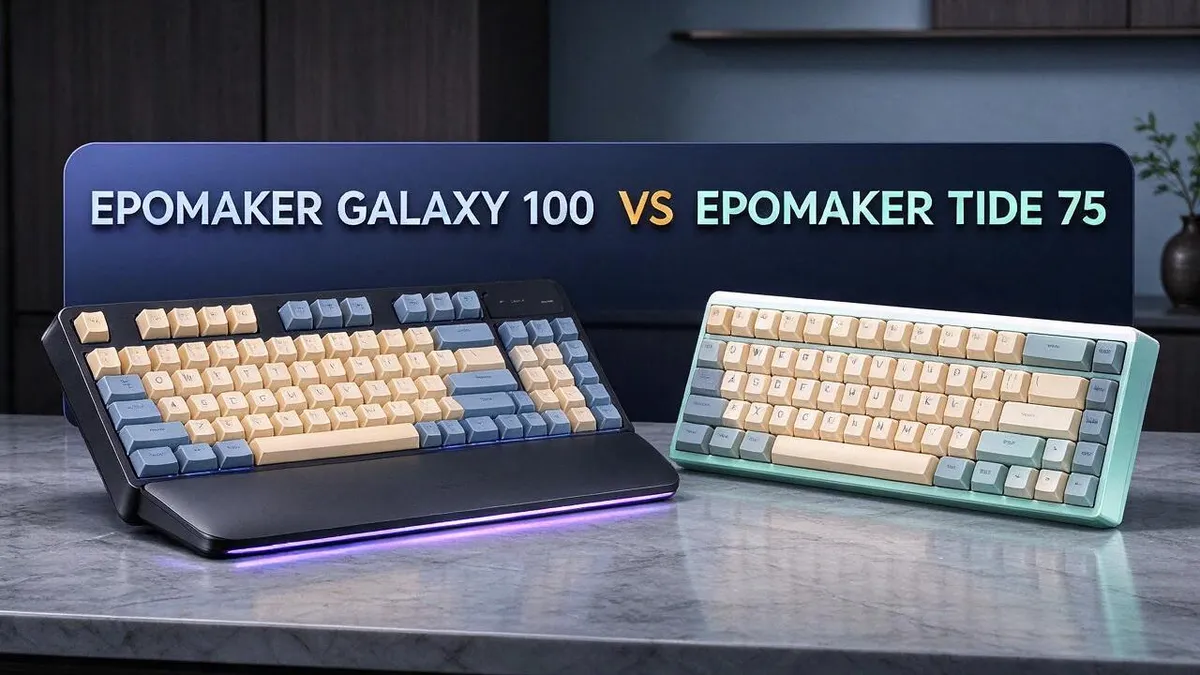
Epomaker Galaxy 100 vs Epomaker Tide 75: Which 75% vs 96% Wireless Keyboard Wins?
Epomaker Galaxy 100 and Epomaker Tide 75 are two popular choices from the same brand. They share an aluminum build and a gasket mount, but they take very different paths in size, layout, and feel.
The Galaxy 100 is a 96% board with 100 keys, a rotary knob, and a powder coated aluminum case that feels premium. It also offers a gasket mount, a hot swap PCB, and an 8000mAh battery in its standard model for long sessions.
The Tide 75 takes the compact route with a 75% layout and a two part aluminum frame. Reviewers often praise its solid chassis and strong build quality, which makes it a great pick for gaming desks and compact setups.
This post will help you pick the right one for your desk, your games, and your daily typing. We compare layout, battery, weight, switches, and overall build, so you can choose with confidence and find the keyboard that fits your setup.
Quick Comparison: Epomaker Galaxy 100 vs Epomaker Tide 75
| Feature | Epomaker Galaxy 100 | Epomaker Tide 75 |
|---|---|---|
| Layout | 96% (100 keys + knob) | 75% compact |
| Case material | Powder-coated aluminum | Two-part aluminum frame |
| Mounting | Gasket-mounted | Gasket mount |
| Battery | 8000mAh (Lite: 4000mAh) | 4000mAh |
| Wireless | Tri-mode, hot-swap PCB | Tri-mode (BT/2.4GHz/USB-C) |
| Stock switches | Wisteria (Lite only) | Lemon linear |
| Best use | Desk setups needing numpad | Compact budget gaming board |
Epomaker Galaxy 100 Review

- 1800 QMK Aluminum Keyboard with Enhanced Typing Sound: Drawing from the success of Galaxy80 and Galaxy70, the...
- QMK/VIA Keyboard with Multi-Device Compatibility: To elevate your typing experience, the Galaxy100 keyboard is...
- Long-Lasting Wireless Performance: Powered by the outstanding 8000mah battery, the Galaxy100 keyboard gives you...
Last update on 2026-10-28 / Affiliate links / Images from Amazon Product Advertising API
The Galaxy 100 suits desk setups that need a numpad and an ANSI layout. It gives you wide typing space for spreadsheets, coding, and long gaming sessions, plus tri-mode wireless for cable-free use.
Inside, the gasket-mounted design softens each keystroke and cuts harsh noise. The hot-swap PCB lets you change switches without soldering, and QMK/VIA support helps you remap keys in a few clicks.
Battery life is a strong point for the standard model, which carries an 8000mAh battery for long wireless sessions. The Lite version swaps in a 4000mAh cell and a full CNC aluminum chassis for a different feel.
Real-world performance feels smooth, and reviewers often call the sound quality exceptional. The Lite is heavy at 1.66kg, so it suits a fixed desk better than a travel bag.
Pros – Numpad and ANSI layout for data entry – Tri-mode wireless with a hot-swap PCB – QMK/VIA support for easy remapping – Exceptional sound quality, according to reviewers
Cons – The Lite version weighs 1.66kg – Lite reliability is still an open question – Sources offer little long-term testing data
Epomaker Tide 75 Review

- 【Optimized 75% Compact Layout&Innovative Gasket Structure】The F75 redefines space efficiency with its...
- 【Acoustic Mastery with Five-Layer Padding】The F75 boasts a five-layer sound and shock-absorbing internal...
- 【Precision-Engineered 1.2mm PCB&Pre-Lubricated Mechanical Switches】At the heart of the F75 is a meticulously...
Last update on 2026-10-04 / Affiliate links / Images from Amazon Product Advertising API
The Epomaker Tide 75 is a compact 75% keyboard made for people who want less desk clutter. It suits gamers and daily typists who value a smaller footprint over a dedicated numpad.
The board sits on a two-part aluminum frame that feels solid in the hand. Reviewers often praise its chassis solidity and build quality, which gives it a sturdy feel on the desk.
A rotary dial gives you quick volume control and handy shortcuts. Tri-mode connectivity lets you switch between Bluetooth, 2.4GHz, and USB-C, so you can move between devices with ease.
Typing and gaming feel smooth with Lemon linear switches installed from the factory. The 4000mAh battery supports wireless use, and QMK/VIA support lets you remap keys to match your workflow.
Pros – Compact 75% layout saves desk space – Solid two-part aluminum frame – Tri-mode wireless with a USB-C option – QMK/VIA support for easy key remapping
Cons – No numpad for heavy data entry – Two variants exist, so check which one you buy – Side-printed and no-side-print versions differ in looks and switches
Head to Head: Key Differences
The biggest difference is size. The Galaxy 100 needs more desk width, while the Tide 75 fits into tight spaces.
A compact board leaves more room for a wide mouse pad. The Galaxy 100 can feel crowded on a small desk.
Typing style matters too. Writers, coders, and spreadsheet users will likely prefer the Galaxy 100.
Its full key set makes long sessions feel natural. Gamers who want fast wrist movement may like the Tide 75 instead.
Gaming changes the picture. The Tide 75 is marketed as a gaming keyboard. A smaller layout shortens mouse travel.
That can help during fast matches.
Travel and portability are different. The Tide 75 slides into a bag more easily. The Galaxy 100 suits a fixed desk better.
Switch feel is another point. The Galaxy 100 Lite arrives with Wisteria switches, while the Tide 75 uses Lemon linear switches. Your switch preference should guide the choice.
Desk setup plays a role too. A wide desk suits the Galaxy 100 well.
Small desks and shared spaces suit the Tide 75 better.
Choose based on your daily tasks. Pick the Galaxy 100 for spreadsheets, writing, and a wireless desk setup. Pick the Tide 75 for a clean desk, gaming, and a compact board you can move around.
Check the variant before buying. Lite and standard versions differ in build and battery.
Read the listing closely before you order. In short, both boards serve different people well.
Which One Should You Buy
The Epomaker Galaxy 100 is the overall winner in this comparison. It offers a numpad, a larger standard 8000mAh battery, and a premium powder coated aluminum build.
Reviewers also praise its sound quality. The Tide 75 is a solid, compact aluminum board, but it lacks the Galaxy’s layout versatility.
For most desk users, the Galaxy 100 offers more value. Its flexible layout makes it the better pick overall.
Best for each buyer
- Epomaker Galaxy 100: Desk users who need a numpad, an ANSI layout, and wireless hot swap. It also suits buyers who want a premium feeling board with good sound, and the standard model over the heavier Lite.
- Epomaker Tide 75: Shoppers who want a compact aluminum keyboard with a rotary dial, three connection modes, and a gaming focus. It works especially well when desk space is limited.
Frequently Asked Questions
Which keyboard lasts longer on one charge?
The Galaxy 100 has the bigger battery in its standard form. It holds 8000mAh, while the Tide 75 holds 4000mAh.
The Galaxy 100 Lite drops to 4000mAh, so check the version before you order.
Does the Galaxy 100 Lite change the choice?
Yes, it can. The Lite uses a full CNC aluminum chassis and ships with Wisteria switches.
It also has a smaller battery than the standard Galaxy 100.
Can I use both keyboards wirelessly?
Yes, both support tri mode wireless. You can connect to several devices and switch between them.
The Tide 75 also offers a USB C option for a wired setup.
What should I check before buying?
Start with your desk space and the layout you need. Next, check the variant, because the Tide 75 comes in two forms.
Finally, pick the switch type that suits your typing style.

Sili is a tech reviewer who cuts through the hype to find AI tools and gadgets that make life easier. She shares honest reviews and simple guides for everyday tech users.