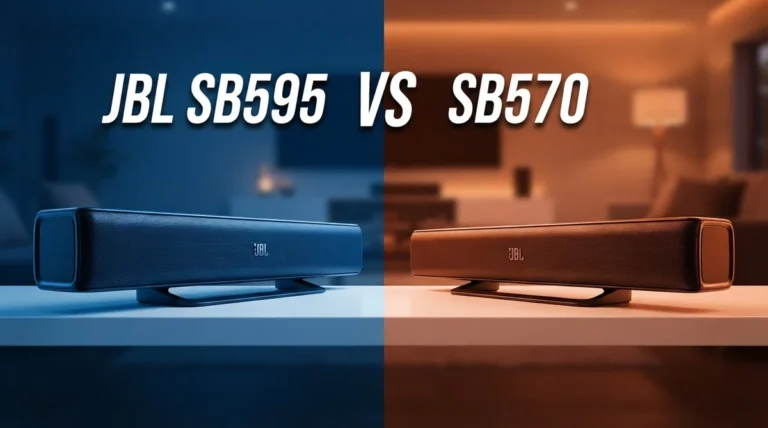

JBL SB595 vs SB590: Which Dolby Atmos Soundbar is Better?
Are you stuck between the JBL Cinema SB595 and the JBL Cinema SB590? You are not alone. These two soundbars come from one of the most trusted audio brands on the planet. They look similar. They cost about the same. They even share the same 440W total power output. So what exactly separates them?
The answer lies in the details. One offers True Dolby Atmos with dedicated up-firing speakers. The other relies on Virtual Dolby Atmos processing. That single difference changes the entire audio experience. But there are other differences too, from channel configuration to Bluetooth version and even physical size.
In this detailed comparison guide, I break down every important factor. You will learn which soundbar delivers better surround sound, which one offers clearer dialogue, and which one gives you more value for your money. Whether you are a movie lover, a music fan, or a casual TV viewer, this guide helps you pick the right soundbar. Let’s dive straight into it.
Key Takeaways
- The JBL SB595 is a 3.1.2 channel soundbar with True Dolby Atmos and dedicated up-firing drivers. It creates a real overhead sound effect that Virtual Atmos cannot replicate.
- The JBL SB590 is a 3.1 channel soundbar with Virtual Dolby Atmos. It uses audio processing to simulate surround effects instead of physical height channels.
- Both soundbars deliver 440W of total system power and come with a wireless 6.5 inch subwoofer for deep bass.
- The SB595 has Bluetooth 5.4, while the SB590 uses Bluetooth 5.3. Both support wireless music streaming from any mobile device.
- The SB595 is slightly larger and heavier at 39.4 inches wide and 7.1 lbs, compared to the SB590 at 37.4 inches wide and 5.7 lbs.
- Both models include a dedicated center channel for superior voice clarity, HDMI eARC, HDMI input, and optical audio connections.
JBL Cinema SB595 Overview
No products found.
The JBL Cinema SB595 is the newer and more advanced model in this comparison. It features a 3.1.2 channel configuration that includes two dedicated up-firing drivers. These drivers bounce sound off your ceiling to create a genuine overhead audio effect. This is what JBL calls True Dolby Atmos.
The soundbar packs three racetrack drivers (48 x 90 mm each), two 1.5 inch tweeters, and two 2 inch up-firing drivers inside a 39.4 inch wide bar. The wireless 6.5 inch subwoofer handles the low end with 240W of dedicated power. The soundbar itself puts out 200W.
Connectivity options include one HDMI input, one HDMI eARC output, optical audio, USB (for mp3 playback in the US version), and Bluetooth 5.4. The total system power reaches 440W. HDCP 2.3 support means you can pass through 4K protected content without issues.
The SB595 has been popular at retailers like Costco, where it typically sells between $239 and $360. It is a strong competitor to the Samsung Q600C and similar mid-range Dolby Atmos soundbars.
JBL Cinema SB590 Overview
The JBL Cinema SB590 takes a slightly different approach. It uses a 3.1 channel configuration without up-firing speakers. Instead of bouncing sound off the ceiling, it relies on Virtual Dolby Atmos processing to simulate a 3D sound field. This processing uses algorithms to create a sense of height and width from standard speaker drivers.
Inside the bar, you get three racetrack drivers (45 x 100 mm each) and three 13mm tweeters. The soundbar output power is 240W, while the wireless subwoofer delivers 200W. That adds up to the same 440W total system power as the SB595. The subwoofer is an identical 6.5 inch wireless unit.
The SB590 measures 37.4 inches wide and weighs just 5.7 lbs, making it about two inches shorter and 1.4 lbs lighter than the SB595. Connectivity includes HDMI input, HDMI eARC output, optical audio, USB, and Bluetooth 5.3.
This model is widely available in international markets, especially India. In the US, the equivalent model is sold as the JBL Cinema SB580 with identical specifications and features.
True Dolby Atmos vs Virtual Dolby Atmos
This is the biggest difference between these two soundbars. The SB595 supports True Dolby Atmos with physical up-firing speakers. The SB590 uses Virtual Dolby Atmos through signal processing.
True Dolby Atmos uses dedicated drivers that fire sound upward toward your ceiling. The sound reflects back down, creating a genuine sense of height. You can hear raindrops falling from above. You can track a helicopter as it flies overhead. This effect feels real and three-dimensional.
Virtual Dolby Atmos relies on psychoacoustic processing. It manipulates the sound from standard forward-facing speakers to trick your brain into thinking sound comes from above and around you. The effect works reasonably well in small to medium rooms. But it cannot match the precision and immersion of real up-firing speakers.
If you watch a lot of Dolby Atmos content on streaming services like Netflix, Disney Plus, or Apple TV Plus, the SB595 gives you a noticeably better experience. For casual TV watching and music, the SB590’s virtual processing still sounds great and may be enough for your needs.
Sound Quality and Performance
Both soundbars deliver powerful, room-filling audio. The 440W total output is impressive for this price range. Bass response starts at 40Hz on both models, which means you get deep, punchy low frequencies from the wireless subwoofer.
The SB595 has a slight edge in overall sound quality. Its 3.1.2 channel setup creates a wider and taller soundstage. Movie scenes feel more cinematic because of those up-firing drivers. The additional height channels add an extra layer of detail that the SB590 cannot fully replicate with processing alone.
The SB590 holds its own with excellent stereo performance and strong bass response. Its racetrack drivers are slightly larger (45 x 100 mm vs 48 x 90 mm), which gives them a different tonal character. Music playback sounds warm and full on both models.
Both soundbars include a dedicated center channel driver for dialogue clarity. This feature keeps voices front and center during movies. You will not struggle to hear what characters are saying, even during loud action scenes. This is a real advantage over cheaper 2.1 channel soundbars that blend dialogue into the left and right channels.
Top 3 Alternatives for JBL Cinema SB595
If you want to explore other options before making a decision, here are three popular alternatives worth considering.

- Dedicated Center Channel Provides Audio Clarity
- 440W Power Output
- Extra deep bass with wireless subwoofer
Last update on 2026-09-01 / Affiliate links / Images from Amazon Product Advertising API

- Bring the power: Fill your whole room with sound. An impressive 300W of total system power puts you in control...
- Surround yourself with sound: JBL Surround Sound instantly brings movies, sports and music to life. Upgrade to an...
- All about the bass: Why just listen to the bass when you can experience it. The 6.5’’ wireless subwoofer...

Last update on 2026-09-01 / Affiliate links / Images from Amazon Product Advertising API

- Dolby Atmos and MultiBeam Surround Sound: Immerse yourself in theater-quality 3D surround sound. Hear extraordinary...
- Built-In Wi-Fi with AirPlay, Alexa Multi-Room Music and Chromecast built-in: Get ready to explore. Access over...
- With 590 watts of total system output power, the JBL Bar 500 transforms your movies, music and games into immersive...
Last update on 2026-08-31 / Affiliate links / Images from Amazon Product Advertising API
Bass Performance and Subwoofer
Both models come with a wireless 6.5 inch subwoofer. The subwoofer connects to the soundbar over a 2.4GHz wireless link. There are no cables running between the subwoofer and the soundbar, which keeps your setup clean.
The subwoofer dimensions are nearly identical. Both measure roughly 7.9 x 15.9 x 9.9 inches. The SB595 subwoofer weighs 13 lbs, while the SB590 subwoofer weighs 12.6 lbs. This small weight difference has no practical impact on bass performance.
One interesting detail is the power distribution. The SB595 sends 240W to its subwoofer and 200W to the soundbar. The SB590 flips this ratio, sending 200W to the subwoofer and 240W to the soundbar. In practice, both subwoofers deliver deep, satisfying bass that you can feel during explosions and action scenes.
You can place the subwoofer anywhere in your room within wireless range. Most users find the best results with the subwoofer near a wall or corner, which naturally amplifies low frequencies. Both models perform well in rooms up to about 300 to 400 square feet.
Connectivity and Inputs
Both soundbars offer a solid set of connectivity options. You get one HDMI input, one HDMI eARC output, one optical audio input, USB, and Bluetooth.
The HDMI eARC connection is the recommended setup method. It carries the highest quality audio signal from your TV to the soundbar. This includes full Dolby Atmos metadata, which is essential for getting the best surround sound experience. Both models support HDCP 2.3, so 4K content from streaming boxes and gaming consoles passes through without issues.
The HDMI input lets you connect a source device directly to the soundbar. This is useful if your TV has limited HDMI ports. The optical input serves as a backup connection for older TVs that lack HDMI ARC or eARC.
The SB595 uses Bluetooth 5.4, while the SB590 uses Bluetooth 5.3. Both versions support the A2DP 1.3 and AVRCP 1.6 profiles. The newer Bluetooth 5.4 on the SB595 offers minor improvements in range and connection stability, but most users will not notice a meaningful difference in daily use.
Design and Build Quality
The SB595 and SB590 share a similar design language. Both feature a sleek, low-profile rectangular bar in black. They are designed to sit below your TV on a stand or mount to the wall using the included bracket kit.
The SB595 is the larger of the two at 39.4 x 2.6 x 3.8 inches. Its extra length comes from housing the additional up-firing drivers. It weighs 7.1 lbs. Users report that the top surface can be a fingerprint magnet, so you may need to wipe it down occasionally.
The SB590 is more compact at 37.4 x 2.5 x 3.1 inches and weighs 5.7 lbs. This smaller size makes it a better fit for tighter entertainment centers or smaller TV setups. If your TV is 50 inches or smaller, the SB590 may look more proportional.
Both models come with a remote control and batteries in the box. You also get an HDMI cable, wall mount bracket with screws, a wall mount template, and power cords. The packaging is straightforward, and setup takes about 10 to 15 minutes.
Movie and TV Performance
This is where the SB595 pulls ahead. Movie soundtracks with Dolby Atmos encoding benefit directly from those up-firing drivers. Action movies like Top Gun: Maverick or Dune sound genuinely immersive. Overhead effects like rain, aircraft, and ambient noise feel like they exist above you.
The SB590 still does a fine job with movies. Its Virtual Dolby Atmos processing creates a wider soundstage compared to a standard stereo soundbar. Dialogue stays clear through the dedicated center channel. Bass hits hard during action sequences thanks to the wireless subwoofer.
Both soundbars include multiple sound modes that you can cycle through using the remote. These modes optimize the audio profile for different content types. Movie mode emphasizes surround effects and bass. Music mode focuses on clarity and stereo separation. A night mode reduces bass and dynamic range for late-night viewing.
For regular TV watching like news, sports, and reality shows, both models perform equally well. The dedicated center channel on both soundbars makes spoken dialogue easy to understand. You will not miss a word, even at low volume levels.
Music Listening Experience
Both soundbars double as capable wireless Bluetooth speakers. You can stream music directly from your phone, tablet, or laptop without turning on the TV. The Bluetooth connection pairs quickly and stays stable on both models.
The SB590 delivers a warm, full sound for music. Its slightly larger racetrack drivers (45 x 100 mm) produce rich midrange frequencies. Vocals sound clear and present. The 6.5 inch subwoofer adds weight to basslines and drums without overpowering the mix.
The SB595 offers a similar music experience with the added benefit of its up-firing drivers. These drivers add a sense of spaciousness to music playback. Live concert recordings and orchestral tracks sound particularly impressive, as the height channels create a more open and airy presentation.
Neither soundbar supports Wi-Fi streaming, Chromecast, AirPlay, or Spotify Connect. You are limited to Bluetooth for wireless music playback. If you need advanced streaming features, you may want to look at higher-end options like the JBL Bar 500 or JBL Bar 1000.
Setup and Ease of Use
Setting up either soundbar is simple. You unbox the soundbar and subwoofer, plug them both into power outlets, and connect the soundbar to your TV using the included HDMI cable. The subwoofer pairs automatically with the soundbar when both are powered on.
For the best audio quality, use the HDMI eARC connection. Plug the HDMI cable into the eARC port on your TV and the eARC output on the soundbar. Make sure your TV’s audio output settings are configured to send audio through the HDMI ARC or eARC port. Most modern TVs detect the soundbar automatically.
Wall mounting is straightforward with the included bracket kit and template. The template helps you mark drill holes accurately. Both soundbars are light enough that the included screws and brackets hold them securely.
The remote control is basic but functional. It lets you adjust volume, switch inputs, change sound modes, and control bass and treble levels. Neither soundbar has a dedicated mobile app for advanced settings. This keeps things simple, though some users may wish for more customization options.
Price and Value Comparison
The JBL Cinema SB595 typically sells for $239 to $360 depending on the retailer and any ongoing promotions. Costco has been a popular source for this model in the US market.
The JBL Cinema SB590, sold as the SB580 in the US, usually costs around $180 to $280. This makes it the more affordable option by a noticeable margin.
The price difference of roughly $50 to $80 between the two models comes down to one main feature: True Dolby Atmos vs Virtual Dolby Atmos. If you watch a lot of Atmos-encoded content and want the most immersive experience possible, the SB595 justifies its higher price. Those up-firing drivers make a real difference.
If you primarily watch regular TV, stream music, or use your soundbar for casual entertainment, the SB590 offers excellent value at its lower price point. You still get 440W of power, a wireless subwoofer, a dedicated center channel, and solid overall sound quality.
Which One Should You Buy?
Choosing between the SB595 and SB590 depends on your priorities and how you plan to use the soundbar.
Buy the JBL Cinema SB595 if you watch a lot of Dolby Atmos movies and TV shows. The True Dolby Atmos with up-firing speakers gives you a noticeably better surround sound experience. You want the most immersive audio possible without spending $500 or more on a premium soundbar system.
Buy the JBL Cinema SB590 if you want great sound at a lower price. You mostly watch regular TV, stream music, and occasionally enjoy movies. The Virtual Dolby Atmos processing still adds a sense of spaciousness that beats any standard stereo soundbar.
Both models share the same subwoofer quality, center channel clarity, and overall build quality. Neither will disappoint you. The SB595 is the better pick for dedicated home theater fans. The SB590 is the smarter pick for budget-conscious buyers who still want powerful JBL sound.
Pros and Cons Summary
The JBL Cinema SB595 brings several strong advantages. True Dolby Atmos with physical up-firing drivers delivers a genuine 3D sound experience. The 3.1.2 channel configuration adds real height to your audio. Bluetooth 5.4 provides the latest wireless standard. The dedicated center channel keeps dialogue crystal clear.
On the downside, the SB595 is larger and heavier. It costs more than the SB590. It does not support Wi-Fi, Chromecast, or AirPlay. There is no dedicated mobile app for fine-tuning settings.
The JBL Cinema SB590 wins on affordability and compactness. It delivers 440W of powerful sound with a great wireless subwoofer. The 3.1 channel layout with a center channel driver handles dialogue well. Its smaller size fits more TV setups.
The drawbacks include Virtual Dolby Atmos instead of True Dolby Atmos. It lacks up-firing drivers, so overhead sound effects are simulated rather than real. Bluetooth 5.3 is slightly older than the SB595’s 5.4 version, though this has minimal real-world impact.
Final Verdict
Both the JBL Cinema SB595 and JBL Cinema SB590 are impressive soundbars for their respective price ranges. They share the same 440W power output, the same wireless subwoofer design, and the same commitment to clear dialogue through a dedicated center channel.
The SB595 stands out for movie lovers and home theater enthusiasts. Its True Dolby Atmos with up-firing drivers creates a level of immersion that Virtual Atmos cannot match. If you regularly stream Atmos content and want the closest thing to a surround sound system without extra speakers, the SB595 is the one to get.
The SB590 stands out for everyday users who want a big upgrade from their TV speakers. It delivers excellent audio quality, strong bass, and a wider soundstage than any 2.1 channel bar at this price. It is lighter, more compact, and easier on the wallet.
Either way, you are getting a quality JBL product with reliable performance and impressive sound for the money.
Frequently Asked Questions
Is the JBL SB595 worth the extra cost over the SB590?
Yes, if you watch a lot of Dolby Atmos content. The True Dolby Atmos experience with physical up-firing speakers on the SB595 creates a more immersive sound than the SB590’s Virtual Atmos. For casual TV watching and music, the difference is less significant, and the SB590 may serve you just as well.
Can I use the JBL SB590 or SB595 with any TV brand?
Yes. Both soundbars work with any TV that has an HDMI ARC, HDMI eARC, or optical audio output. They are not limited to a specific TV brand. You simply connect the soundbar to your TV using the included HDMI cable or an optical cable.
Do these soundbars support Wi-Fi or smart assistant integration?
No. Neither the SB595 nor the SB590 supports Wi-Fi, Chromecast, AirPlay, or smart assistants like Alexa or Google Assistant. They use Bluetooth for wireless music streaming. If you need Wi-Fi and smart features, consider the JBL Bar 500 or JBL Bar 1000.
What is the difference between the JBL SB590 and SB580?
The JBL SB590 and SB580 are essentially the same soundbar sold in different regions. The SB580 is the model name used in markets like the US and Canada. The SB590 is sold in India and other international markets. Specifications, features, and performance are identical.
How far can the wireless subwoofer be placed from the soundbar?
The wireless subwoofer connects over a 2.4GHz wireless link. In most homes, you can place it up to 30 feet from the soundbar without connection issues. For the best bass performance, keep it in the same room as the soundbar, ideally near a wall or corner.
Does the JBL SB595 support 4K passthrough?
Yes. The SB595 supports HDCP 2.3, which allows 4K content to pass through its HDMI input to your TV without issues. This includes protected content from streaming devices, Blu-ray players, and gaming consoles. The SB590 also supports the same HDCP 2.3 standard.

Sili is a tech reviewer who cuts through the hype to find AI tools and gadgets that make life easier. She shares honest reviews and simple guides for everyday tech users.