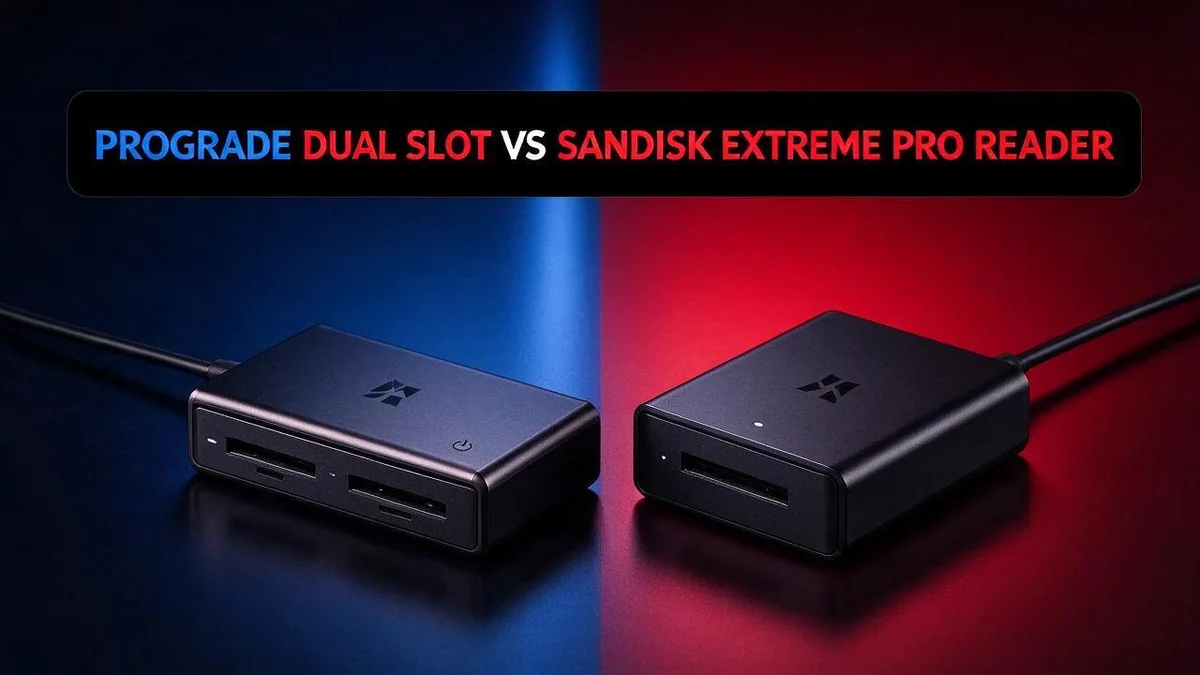
ProGrade Dual Slot vs SanDisk Extreme Pro Reader: Which Card Reader Wins?
Choosing the right memory card reader can feel confusing for photographers and videographers who handle large files every day. Two popular options often top the shortlist: the ProGrade Dual Slot and the SanDisk Extreme Pro Reader.
The ProGrade Dual Slot is built for fast, structured workflows on busy shoot days. It holds two cards at once and supports UHS-II SD cards, so offloading and backups stay simple and quick.
The SanDisk Extreme Pro Reader takes a simpler and more flexible path. It offers one SD slot with a USB-C 10Gbps connection that works well with iPads and portable drives, plus broad SD card support for mixed card collections.
This head to head guide compares slot count, UHS-II support, interface, and best use cases for each reader side by side. You will learn which reader fits your card collection, your workflow, and your daily shoot, so you can choose with confidence and get the most from your gear.
Quick Comparison: Prograde Dual Slot vs Sandisk Extreme Pro Reader
| Feature | Prograde Dual Slot | Sandisk Extreme Pro Reader |
|---|---|---|
| Slot count | Dual-slot | Single-slot SD |
| Card support | UHS-II SD and CFast/CFexpress | UHS-I, UHS-II, non-UHS SD |
| Interface | USB 3.2 Gen 2 or USB4 | USB-C 10Gbps |
| UHS-II support | Yes | No (Pro-Reader model) |
| Transfer speed | Not stated in sources | Full speed only with UHS-I (QuickFlow) |
| Design size | Larger (USB4 model) | Not stated in sources |
| Best use | Dual-card ingest and backup | Single-card SD offload, mobile USB-C |
Prograde Dual Slot Review

- DO MORE OF WHAT YOU LOVE: Because the ProGrade Digital™ USB 3.2 Gen 2 Dual-Slot SD™ UHS-II...
- DESIGNED FOR LIFE ON THE ROAD: Wherever you go, your included adhesive metal plate attaches the magnetic card...
- Pro Level Confidence: When success depends on your equipment, you need the very best. The ProGrade Digital SD...
Last update on 2026-10-28 / Affiliate links / Images from Amazon Product Advertising API
The ProGrade Dual Slot suits photographers and videographers who shoot with two cards at once, such as event or wedding crews. It fits best for dual-card ingest from UHS-II SD or CFexpress workflows.
It connects through USB 3.2 Gen 2 and supports CFast and SD variants. A newer USB4 model also adds CFexpress Type A and SDXC UHS-II support.
Reviewers praise the design for offloading and backup tasks, which saves time on set. A 2019 review found it fit smoothly into structured workflow routines, which keeps long shoot days organized.
In one reviewer’s tests, ProGrade cards read much faster than SanDisk CF cards. That result reflects the cards themselves, not the reader alone, and exact transfer speeds are not listed.
Pros – Two slots allow simultaneous offload and backup – Supports UHS-II SD and CFast cards – USB4 model adds CFexpress Type A support – Fits structured workflow routines well
Cons – The USB4 model has a larger design – Exact transfer speeds are not published in available sources – Few reader-specific drawbacks appear in published reviews
Sandisk Extreme Pro Reader Review

- Optimize the performance of CFexpress Type B media for smooth and efficient workflows from location to post...
- This reader connects to your host system using a 10 Gb/s USB 3
- 1 Gen 2 Type-C port and an included 1
Last update on 2026-10-28 / Affiliate links / Images from Amazon Product Advertising API
The SanDisk Extreme Pro Reader is a single-slot SD card reader for photographers and videographers who work with one card at a time. It suits anyone who offloads footage from a camera card to a laptop, tablet, or external drive.
It connects through USB-C at 10Gbps, so it fits iPads and G-RAID drives with ease. Broad SD support also means it reads UHS-I, UHS-II, and non-UHS cards.
Speed depends on the model you choose. The Pro-Reader does not support UHS-II speeds, while the QuickFlow version runs at UHS-I speed when you use UHS-II cards.
For everyday offload work, full speed comes from UHS-I cards on the QuickFlow model. Build quality details are limited in the available sources, so check the model specs before you buy.
Pros
- Works with UHS-I, UHS-II, and non-UHS SD cards
- USB-C 10Gbps connection fits iPads and G-RAID drives
- Strong choice for single-card SD offload tasks
- Handles mixed UHS-I and UHS-II card collections
Cons
- The Pro-Reader model lacks UHS-II speeds
- QuickFlow drops to UHS-I speed with UHS-II cards
- Single-slot design handles one card at a time
Head to Head: Key Differences
Slot count is the first big difference. The ProGrade Dual Slot has two slots, so you can offload and back up at the same time.
The SanDisk Extreme Pro Reader has one SD slot, so you copy one card at a time.
UHS II support matters for fast cards. ProGrade builds its reader around UHS II speeds.
The SanDisk Pro Reader model does not support UHS II, so those cards run slower in it.
The SanDisk QuickFlow model works differently. It gives full speed with UHS I cards, but UHS II cards drop to UHS I speed.
If your collection mixes card types, this difference matters a lot.
Connection and devices also shape your choice. ProGrade offers USB 3.2 Gen 2 and a newer USB4 model.
The SanDisk reader uses a 10Gbps USB C connection, so it fits iPads and G RAID drives.
Size is one trade off. A review notes that the USB4 ProGrade unit has a larger body. That can matter if you pack light or work from a small bag.
One reviewer found that ProGrade cards read much faster than SanDisk CF cards. That result reflects the cards, not the readers.
Exact ProGrade transfer speeds are not published in available sources.
Choose ProGrade when you shoot with two cards and need steady ingest on busy days. Choose SanDisk when you offload one SD card at a time or work from an iPad on location.
Which One Should You Buy
The ProGrade Dual Slot is the overall winner. It gives you two card slots for offloading and backup at the same time.
It also supports UHS-II cards, which the SanDisk Pro-Reader cannot use at full speed. The SanDisk keeps its edge with broad compatibility and handy USB-C, but reader-specific data for ProGrade is limited.
For fast workflows, that speed and dual-slot design matter most. Shooters who mostly use UHS-I cards may find the SanDisk simpler.
Best for each buyer
- Prograde Dual Slot: Professional photographers and videographers who ingest from two cards at once and shoot with UHS-II SD or CFexpress cards.
- Sandisk Extreme Pro Reader: Mobile users who need a simple, single-card SD reader with USB-C for iPads or G-RAID drives and mostly use UHS-I cards.
Frequently Asked Questions
Which reader works best for one card at a time?
For one card, the SanDisk Extreme Pro Reader is a simple pick. It has one SD slot. You copy one card at a time, which keeps things easy.
Which reader is better for two cards at once?
The ProGrade Dual Slot wins here. It has two slots, so you can offload one card while you back up another. This saves time on busy shoots.
Does card speed affect my choice?
Yes, speed matters a lot. The SanDisk Pro Reader model does not support UHS II speeds. The QuickFlow model drops to UHS I speed with UHS II cards. The ProGrade is built around UHS II, so your fast cards keep their speed.
Can I use the SanDisk reader with an iPad?
Yes. Its USB C connection fits iPads and G RAID drives. This makes it a strong choice for travel and mobile offload work.
Is the ProGrade reader bulky?
The USB4 model has a larger body, according to one review. Pack it with room to spare. If you want a compact option, the SanDisk reader is easier to carry.

Sili is a tech reviewer who cuts through the hype to find AI tools and gadgets that make life easier. She shares honest reviews and simple guides for everyday tech users.