
Sony BRAVIA 2 II vs Samsung Q6F: Which 4K TV Offers Better Picture Quality?
Picking a new TV can feel tricky. Two names often pop up in the same breath: the Sony Bravia 2 II and the Samsung Q6F.
Both are solid 4K displays. But they take very different paths to get you a great picture.
The Sony Bravia 2 II leans on smart processing. It uses its X1 chip to upscale content and smooth out rough edges on lower quality streams.
The Samsung Q6F takes a different route. It uses Quantum Dot color technology to deliver vivid, accurate colors across different lighting conditions.
So which one fits your living room? That depends on what you watch and how you watch it.
This guide breaks down specs, strengths, and weaknesses side by side. We will look at panel technology, brightness, refresh rates, and connectivity.
By the end, you will know exactly which TV suits your needs. Let’s get into the details.
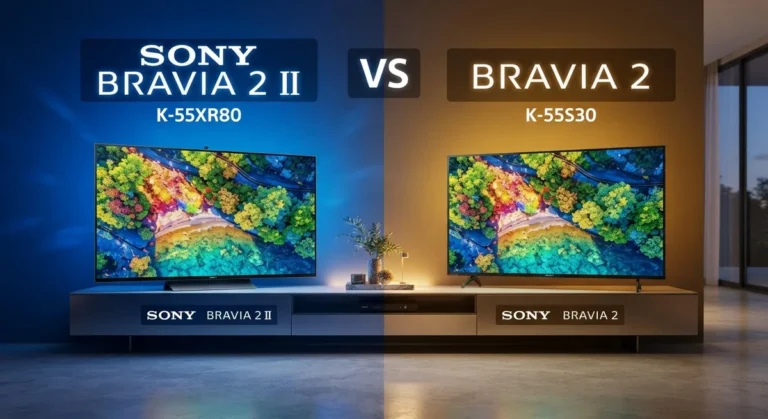
Quick Comparison: SONY Bravia 2 Ii vs Samsung Q6F
| Feature | SONY Bravia 2 Ii | Samsung Q6F |
|---|---|---|
| Panel Type | Direct-lit LED | Edge-lit QLED |
| Resolution | 4K, 55″/65″ | 4K, 55″/65″ |
| Refresh Rate | 60Hz | 50Hz |
| HDR Support | Limited brightness for HDR | HDR10+, 250 nits |
| Processing | 4K Processor X1 upscaling | 4K upscaling, quantum dot |
| Smart Platform | Google TV | Tizen OS |
| Connectivity | 4 HDMI, Wi-Fi 6 | 3 HDMI ports |
| Best Use Case | Group/casual viewing | Gaming/PC monitor use |
SONY Bravia 2 Ii Review
The Sony BRAVIA 2 II is a direct-lit LED 4K display available in 55″ and 65″ sizes. It works best for viewers who watch mixed content and value smart picture processing over raw brightness.
This TV packs the 4K Processor X1, which continuously optimizes color, contrast, and sharpness in real time. You get excellent upscaling of lower-quality content, so older shows and streams look sharper than they should.
The direct-lit backlight setup delivers wide viewing angles, meaning the picture stays clear even when you sit off to the side. Google TV comes built in, along with Wi-Fi 6 and Bluetooth 5.3 for smooth streaming and wireless audio.
The 60Hz refresh rate and entry-level positioning mean peak HDR brightness falls short for bright rooms. Still, everyday viewing and group gatherings feel natural and smooth on this set.
Pros
- Real-time processing enhances picture quality across all content types
- Direct-lit backlight gives consistent brightness and wide viewing angles
- Strong upscaling makes lower-resolution streams look sharp
- Four HDMI ports support multiple devices
Cons
- Insufficient brightness for HDR content in bright spaces
- Entry-level specs limit peak performance and gaming features
- 60Hz refresh rate (not ideal for fast-motion sports)
Samsung Q6F Review
The Samsung Q6F is a 55″ or 65″ QLED 4K display built for viewers who want vibrant color and gaming flexibility. This TV uses quantum dot technology to deliver rich, punchy colors across any room lighting condition.
The standout feature is its quantum dot color engine, which produces more vivid hues than standard LED panels. The UHD Dimming system adds depth to dark scenes, and HDR10+ support brings enhanced contrast to compatible content.
Real-world performance shines in gaming and PC monitor use thanks to its 50Hz refresh rate and multiple input options. The Tizen OS gives you access to 2700+ free channels, so you have plenty of content at your fingertips without extra subscriptions.
Build quality feels solid, though the edge-lit backlight is older technology compared to direct-lit designs. Audio performance is notably strong for a mid-range TV, which means you get decent sound without needing external speakers immediately.
Pros
- Quantum dot technology delivers vivid, room-filling colors
- Strong audio output reduces need for soundbars
- Works well as a gaming display and PC monitor
- 2700+ free channels built into Tizen OS
Cons
- Edge-lit backlight limits contrast and brightness for HDR content
- Only 3 HDMI ports instead of 4
- 250 nits brightness falls short in very bright rooms
Head to Head: Key Differences
The Sony BRAVIA 2 II and Samsung Q6F take different approaches to picture quality. Sony bets on intelligent processing, while Samsung focuses on color technology.
Backlight design separates these two TVs fundamentally. Sony uses direct-lit backlighting, which spreads light evenly across the entire panel.
Samsung uses edge-lit backlighting, an older method that concentrates light around the edges.
This matters for brightness and contrast. The Sony delivers more consistent brightness levels across the screen, especially in darker scenes.
The Samsung struggles with contrast on its IPS panel, meaning blacks appear less deep.
Refresh rates differ slightly between them. Sony runs at 60Hz, while Samsung operates at 50Hz.
For casual viewing, this difference is barely noticeable, but gamers might prefer Sony’s extra smoothness.
Processing power works differently too. Sony’s 4K Processor X1 continuously adjusts color, contrast, and sharpness in real time.
This makes older or lower quality streams look sharper and clearer. Samsung prioritizes its quantum dot engine instead, which boosts color vibrancy without real time adjustments.
Connectivity varies in practical ways. Sony includes 4 HDMI ports, giving you room for multiple devices.
Samsung provides only 3 HDMI ports, which limits flexibility if you own several gaming consoles or streaming boxes.
Color reproduction favors Samsung here. Quantum dot technology produces more vivid, room filling hues compared to standard LED panels.
Sony’s direct lit design offers wider viewing angles, so the picture stays clear from different seating positions.
Both TVs struggle with HDR brightness in bright rooms. Neither reaches the peak brightness needed for dramatic HDR impact.
For everyday viewing and upscaling older content, Sony edges ahead. For gaming and color focused entertainment, Samsung performs better.
Which One Should You Buy
The Sony Bravia 2 II takes the win here. Its direct-lit backlight and stronger processor give it better all-around picture quality than the Samsung Q6F.
With a higher 60Hz refresh rate and more HDMI ports, the Bravia 2 II handles everyday viewing with ease. It upscales lower-quality content well too.
Samsung’s Q6F still holds value, but its edge-lit QLED design feels dated next to Sony’s more balanced performance.
Best for each buyer
-
Sony Bravia 2 II: Best for casual and group viewing. It suits people who stream a lot of content and want strong upscaling with real-time picture optimization.
-
Samsung Q6F: Best for gamers and PC monitor users. It suits those who want vibrant quantum dot color and don’t mind trading off some contrast and refresh rate.
Frequently Asked Questions
Which TV handles sports and fast action better?
The Sony BRAVIA 2 II pulls ahead here. Its 60Hz refresh rate keeps motion smoother than Samsung’s 50Hz panel.
You’ll notice the difference most during soccer matches, hockey, or action movies. The Sony’s direct-lit backlight also responds faster to brightness changes on screen.
That said, both TVs work fine for casual sports viewing. Samsung’s Q6F still delivers solid performance.
The gap only matters if you watch fast-paced content constantly.
Can I use either TV as a PC monitor?
Samsung Q6F wins this round. It has multiple input options and works better as a desktop display.
The 50Hz refresh rate suits office work and spreadsheets perfectly. Gamers also prefer its gaming mode features.
The Sony BRAVIA 2 II can connect to a PC, but it’s not optimized for that use. Google TV takes up screen space.
You’re better off sticking with the Samsung if you need monitor functionality.
Which one upscales older movies and streams better?
Sony BRAVIA 2 II dominates here. Its 4K Processor X1 works constantly to sharpen low-quality content.
Older DVDs, streaming services, and compressed videos look noticeably clearer on Sony’s panel.
Samsung’s upscaling is decent but less aggressive. The Q6F focuses more on color vibrancy than sharpness enhancement.
If your library includes lots of older films or lower-resolution streams, Sony gives you sharper results.
Does HDR look better on either TV?
Both TVs struggle with HDR brightness, honestly. Neither reaches the peak brightness needed for true HDR impact.
The Sony BRAVIA 2 II has direct-lit backlighting, which helps with consistency. Samsung’s edge-lit design creates uneven brightness zones.
For HDR fans, both disappoint slightly. You’ll still see HDR content, but the experience won’t blow you away on either model.

Sili is a tech reviewer who cuts through the hype to find AI tools and gadgets that make life easier. She shares honest reviews and simple guides for everyday tech users.