
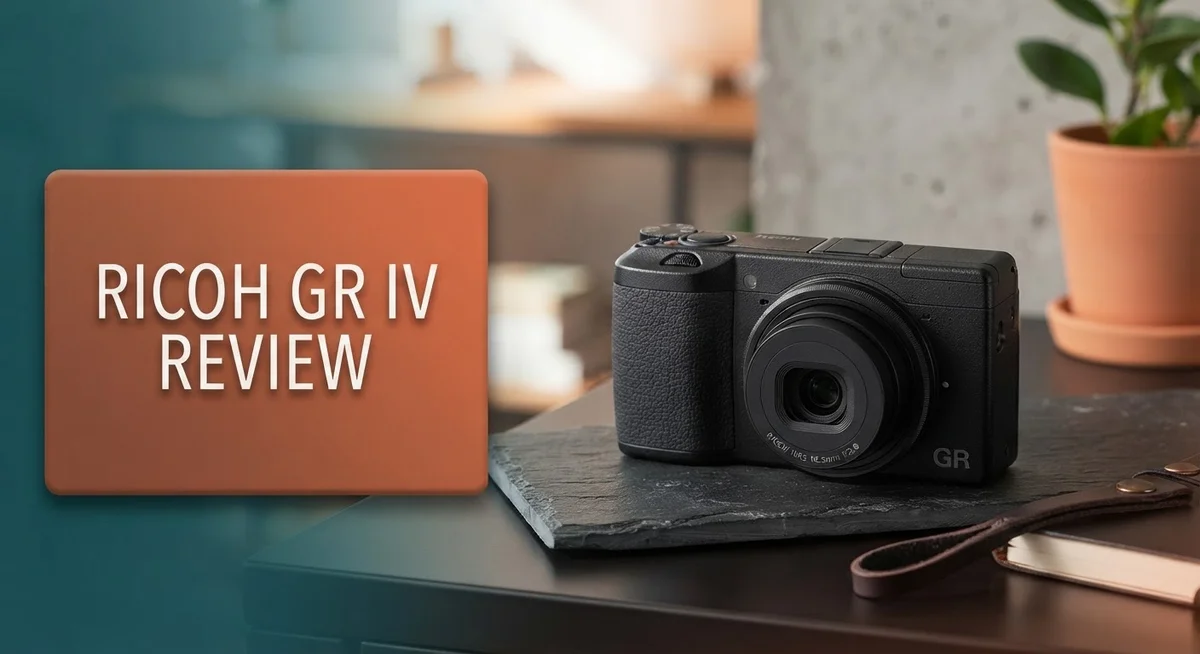
Ricoh GR IV Review: Compact Camera for Street Photography
The Ricoh GR IV is a favorite for street photographers who love small cameras. It packs a 25.7MP APS-C sensor into a tiny body. This camera fits in your pocket but shoots like a pro tool.
Ricoh upgraded the autofocus system this time. The image stabilization also feels smoother than before. You get sharp photos even when you shoot fast on busy streets.
The fixed 28mm lens stays simple and effective. It forces you to think about composition. Many photographers say this limit actually makes them better shooters.
This review looks at what makes the GR IV special. We check the build quality, image results, and daily handling. We also point out some issues you should know before you buy.
Is this camera right for your pocket? Let’s find out together.
In a Nutshell
Here is a quick summary of the Ricoh GR IV before you go further.
- Sensor quality: The 25.7MP APS-C sensor captures sharp, detailed images even in tricky light.
- Stabilization: Optical image stabilization helps you shoot handheld shots without blur.
- Storage flexibility: Internal storage plus microSD support gives you room to shoot more without worry.
- Build concerns: Some users report dust ingress and wear from pocket carry over time.
- Battery life: Expect to carry a spare battery, since battery life can disappoint on long outings.
- Screen clarity: The 3.0″ LCD with about 1.04M dots shows your shots clearly on the go.
- No lens swapping: This camera sticks to one fixed lens, so you won’t change lenses like a mirrorless system.
- Competition: It stands apart from the Ricoh GR II, Fujifilm X-series compacts, and the Olympus Stylus SH-1.
This camera suits photographers who want a compact tool with strong image output. Just keep an eye on durability and battery habits during long shooting days.
Key Features and Specifications
The Ricoh GR IV packs a 25.7MP APS-C CMOS sensor into a body small enough for your jacket pocket. This sensor delivers sharp, detailed images across a wide range of lighting situations. You get excellent color accuracy and minimal noise even when you push the ISO higher.
The fixed 28mm focal length is a deliberate choice. This lens width works perfectly for street photography and everyday snapshots. The aperture range gives you flexibility without the bulk of zoom lenses. You won’t swap lenses, but you gain speed and simplicity instead.
Optical image stabilization is a major upgrade in this model. Hand holding the camera becomes easier, especially in dim indoor spaces or during golden hour shooting. You can use slower shutter speeds without introducing blur into your photos.
The 3.0 inch LCD monitor displays your images clearly. With approximately 1.04M dots, the screen offers good color reproduction and brightness levels. You can review your shots immediately after capture and adjust your approach for the next frame.
Internal storage comes standard on this camera. You also get a microSD card slot for expanded capacity. This dual storage approach means you can shoot longer sessions without constantly managing files on your computer.
Autofocus performance has seen real improvements. The system locks onto subjects faster and more reliably than previous generations. Continuous autofocus tracking works well for moving subjects, whether you’re capturing street scenes or candid moments.
The build quality feels solid in hand. However, durability remains a consideration for photographers who carry this camera daily in pockets or bags. Some users report dust particles entering the camera body over extended use. The weathersealing is good but not fully sealed against all elements.
Battery capacity is modest. A full charge gets you through a typical day of moderate shooting. Serious photographers should plan to carry a spare battery for longer outings or travel days.
These specifications combine to create a camera that excels at portable, high quality image capture. The feature set focuses on what matters for street and snap photography rather than including unnecessary complexity.

- Built-in HDF (Highlight Diffusion Filter): Diffuses highlights for softer light, creating more expressive images...
- Ultra Compact Design: Smallest GR to date, easily fits in your pocket for convenient portability
- New Image Sensor: 25.74MP Back-illuminated APS-C size equivalent CMOS sensor delivers exceptional image quality

Last update on 2026-10-04 / Affiliate links / Images from Amazon Product Advertising API
Design and Build Quality
The Ricoh GR IV feels like a precision instrument in your hands. The body uses a mix of metal and quality plastic materials that create a camera tough enough for daily use. The compact dimensions make it perfect for photographers who want serious capability without bulk.
The physical layout is intuitive. Controls sit exactly where you expect them. The shutter button has a satisfying click. The mode dial turns smoothly without accidental shifts. Buttons feel responsive and don’t stick or rattle.
One thing stands out about durability. The GR IV faces real challenges with dust protection. Users report that dust can enter the lens barrel during regular pocket carry. This happens because the fixed lens design leaves small gaps. Extended outdoor sessions sometimes result in internal dust spots on the sensor. You’ll want to be mindful of this limitation.
The exterior finish resists fingerprints well. The textured grip keeps the camera secure even with wet hands. The lens barrel rotates smoothly during focus operations. The tripod socket feels sturdy and well placed.
The LCD screen sits flush with the back panel. It doesn’t protrude, which helps prevent accidental damage. The screen itself is protected by Gorilla Glass, so scratches are unlikely from normal use.
Weather sealing exists but has limits. The camera handles light rain without issue. Heavy moisture or sand can still cause problems. This isn’t a rugged adventure camera, even though the build quality is good.
The battery compartment opens smoothly. The memory card slot accepts microSD cards without adapters. Both areas feel secure and properly designed.
Overall, the GR IV presents solid build quality with one major caveat. The dust ingress issue deserves serious consideration if you shoot outdoors frequently. For urban street photography and controlled environments, the construction holds up beautifully. The materials feel premium. The engineering is thoughtful. Just remember that this camera works best when you’re mindful of its limitations around dust and moisture exposure.
Image Quality and Lens Performance
The 25.7MP APS-C sensor delivers exceptional sharpness across the frame. Details remain crisp even when you zoom in on your screen. Colors feel natural and well balanced in most lighting conditions.
The fixed 28mm lens is a smart design choice. This focal length works great for street photography and everyday snapshots. You get a wide enough view without distortion that plagues ultra wide lenses. The lens renders subjects with minimal vignetting at the edges.
Low light performance stands out as a real strength. The sensor handles high ISO values without excessive noise. You can shoot indoors or at dusk without losing image quality. Shadow details stay visible and recoverable during editing.
The optical image stabilization makes a noticeable difference. Handheld shots stay sharp even at slower shutter speeds. You can confidently shoot at 1/15th second without blur in many cases. This feature becomes your best friend in dim environments.
Autofocus speed has improved significantly from older GR models. The camera locks onto subjects quickly and accurately. Continuous autofocus tracks moving subjects smoothly. You rarely experience missed focus moments during real world shooting.
Lens distortion is minimal across the frame. Straight lines stay straight, even near the edges. This makes the GR IV excellent for architectural photography. Chromatic aberration is nearly invisible in typical scenes.
The dynamic range is impressive for a compact camera. Bright skies retain detail while shadows stay visible. You have plenty of room to adjust exposure during post processing. RAW files offer even more flexibility than JPEGs.
Macro focusing capability lets you get close to small subjects. The minimum focus distance is practical for detail shots. You can capture textures and patterns without external lenses.
Lens coatings reduce flare effectively. Backlit scenes produce clean images without ghosting. Contrast remains strong even in challenging lighting. The overall optical design feels mature and refined after years of GR development.
Top 3 Alternatives
Canon PowerShot G7X

- Canon USA Authorized. Items Include: Canon PowerShot G7 X Mark III Digital Camera (Black), NB-13L Battery Pack...
- Crisp Photos in a Compact Package - The PowerShot G7 X Mark III is built for sharp, vibrant photos without the bulk...
- 4K Video Made Simple - Shoot stunning 4K UHD video with no cropping, perfect for YouTube, vlogs, or home videos...
Last update on 2026-10-04 / Affiliate links / Images from Amazon Product Advertising API
The Canon PowerShot G7X offers excellent portability for photographers who want quality without bulk. This camera features a 1-inch sensor that captures sharp images in various lighting conditions. The lens provides a 4.2x zoom range, giving you flexibility for different shooting scenarios.
You’ll appreciate the articulating screen, which tilts for creative angles and selfies. The camera records 1080p video smoothly. Battery life is solid for a day of shooting. The compact design fits easily in your pocket or bag.
Sony RX100 VII

- 20. 1MP 1. 0 Type stacked CMOS sensor, Zeiss Vario Sonnar T 24 200 millimeter F2. 8 F4. 5 large aperture high...
- 0. 02 sec. High AF speed, 357 point focal plane Phase detection AF and 425 point contrast detection AF
- Up to 20 fps blackout free shooting, using up to 60 times/sec. AF/AE calculations. Diopter Adjustment: -4.0 to...
Last update on 2026-10-04 / Affiliate links / Images from Amazon Product Advertising API
Sony’s RX100 VII packs impressive features into a tiny frame. It includes a 1-inch sensor with advanced autofocus that tracks moving subjects reliably. The lens zooms 8x, offering more reach than competitors in this category.
This camera shoots 4K video with excellent stabilization. The tilting screen helps with low-angle shots. Fast performance means you capture moments without lag. The autofocus system is particularly strong for video work. Battery life is adequate for typical outings.
Fujifilm X100V

- Great photography every day, everywhere: X100V features a newly designed, incorporated 23 millimeter F2 lens...
- Designed for quality and speed: From fleeting holiday moments and family celebrations to hard-hitting visual...
- Two ways to see an Image: To truly convey the magic of a scene, you need to be immersed in the moment and X100V’s...
Last update on 2026-10-04 / Affiliate links / Images from Amazon Product Advertising API
The Fujifilm X100V brings unique character to compact photography. Its fixed 35mm lens encourages intentional composition. The X-Trans sensor produces distinctive color rendering that many photographers love.
The camera features a hybrid viewfinder combining optical and electronic views. You get real-time exposure preview before taking shots. Film simulation modes let you apply different looks in-camera. Build quality feels premium with weather-resistant sealing. Battery performance is respectable for extended shooting sessions. The fixed lens means no zoom, but it delivers exceptional image quality at that focal length.
Autofocus, Stabilization, and Handling
The Ricoh GR IV handles autofocus differently than most compact cameras. The camera uses a hybrid autofocus system that combines contrast detection with phase detection points. This means faster lock times, especially when you’re shooting moving subjects or street scenes.
Autofocus speed improved noticeably from the GR II model. You’ll notice quicker acquisition when framing your shot, and the camera rarely hunts for focus in normal lighting. The system works well in low light too, though it can hesitate in very dim conditions. Continuous autofocus tracking performs adequately for casual video work.
Optical image stabilization makes a real difference with the fixed 28mm lens. The stabilization compensates for hand shake, letting you shoot at slower shutter speeds without blur. This is especially helpful indoors or during golden hour photography. The system doesn’t feel intrusive or cause any lag in your shooting experience.
Handling the GR IV feels natural and intuitive. The compact body fits easily in one hand, and the grip provides enough purchase even with larger hands. The physical controls sit exactly where you’d expect them. The shutter button has a satisfying tactile response. The mode dial clicks positively between settings without any slop.
The camera’s small size means less leverage when stabilizing the camera. You’ll want to develop good hand holding technique for the best results. Bracing against a wall or object helps during longer exposures. The tripod socket works fine, though the compact body leaves little room for creative positioning.
Weight distribution feels balanced throughout the body. The lens doesn’t protrude far, so the camera sits flat in a pocket without awkward bulges. The LCD screen is recessed slightly, protecting it from accidental contact. Everything about the physical design encourages you to carry this camera everywhere.
The ergonomic layout supports both one handed and two handed operation. Menu navigation responds quickly to button presses. The joystick controller on the back lets you move focus points smoothly. Overall, the GR IV prioritizes usability alongside its compact form factor.
Battery Life and Storage
The Ricoh GR IV runs on a single lithium ion battery that powers the camera during your shooting sessions. Battery capacity is modest at 1260 mAh, which means you get roughly 200 to 250 shots per full charge under typical shooting conditions.
Real world usage varies based on how often you use the LCD screen. Continuous LCD use drains power faster than using the optical viewfinder alone. Cold weather also reduces battery performance, so expect fewer shots in winter months.
The camera charges via USB C connection, which is convenient for modern workflows. You can charge the battery inside the camera or use an external charger. Charging time takes approximately 2 to 3 hours from empty to full capacity.
Carrying a spare battery is highly recommended for all day shooting sessions. Most photographers report needing one backup battery to comfortably shoot throughout a full day. The battery is compact and lightweight, so it takes minimal space in your camera bag.
Storage on the Ricoh GR IV comes in two forms. The camera includes internal storage that holds approximately 3GB of data. This gives you room for roughly 100 to 150 uncompressed RAW files, depending on your shooting style.
MicroSD card support expands your storage options significantly. The camera accepts cards up to 2TB capacity, though practical limits exist with older file systems. Most photographers use 64GB to 256GB cards for extended shooting trips.
Recording video also uses storage space, so factor this into your planning. The camera shoots 4K video at various frame rates, which consumes storage quickly. A 128GB microSD card provides comfortable space for mixed photo and video work.
The camera supports both JPEG and RAW file formats. RAW files preserve maximum editing flexibility but consume more storage than JPEG. You can set the camera to capture both formats simultaneously if desired.
Transfer speeds to your computer depend on your USB C connection quality. Modern USB C cables provide fast data transfer rates. Backing up your files regularly prevents accidental loss of your images.
Pros and Cons
Pros
- Captures stunning detail with the 25.7MP APS-C sensor and sharp 28mm fixed lens
- Compact size makes it perfect for street photography and everyday carry
- Improved autofocus and optical image stabilization work together smoothly
- Internal storage plus microSD support gives you flexible options for longer shoots
- Natural handling and intuitive controls feel comfortable in your hands
Cons
- Durability concerns exist around pocket wear and dust ingress over time
- Battery life requires you to carry a spare for full day shooting sessions
- Dust protection is not as robust as you might expect from a premium compact
- Fixed 28mm lens means you cannot zoom, limiting your creative framing options
Who Should Buy It
The Ricoh GR IV appeals to street photographers who value compact gear without sacrificing image quality. If you shoot urban scenes, travel frequently, or prefer cameras that fit in your jacket pocket, this camera deserves your attention.
Content creators benefit from the fixed 28mm lens and sharp optics. The focal length works well for vlogging, behind the scenes content, and everyday documentation. The compact body means you can carry it anywhere without fatigue.
Enthusiast photographers who want a second camera will appreciate the GR IV’s simplicity. You don’t need to manage multiple lenses or spend time on technical settings. Just grab it and shoot.
Travel photographers find the lightweight design and internal storage useful. The microSD card support lets you store thousands of images without extra gear. One camera handles everything you need for weeks away from home.
Hybrid workers and remote professionals should consider this camera. Quick lunch break photography sessions become practical. The intuitive controls mean minimal learning curve before you start capturing meaningful moments.
Professional photographers sometimes use the GR IV as a backup or B camera. The reliable autofocus and optical stabilization work consistently. You gain a second perspective without carrying heavy equipment.
However, certain users should look elsewhere. If you need interchangeable lenses, this fixed 28mm design won’t work. Zoom enthusiasts will feel limited by the single focal length.
Photographers who work in dusty environments should be cautious. Dust protection concerns mean the camera requires careful maintenance. Pocket carry over months may cause gradual wear on the body.
Budget conscious buyers might explore the older GR II model instead. That camera still delivers solid image quality for less investment.
Video creators needing extended recording should evaluate alternatives. Battery life and storage space get consumed quickly during video sessions.
Professionals requiring weatherproofing will want cameras with better dust sealing. The GR IV’s durability limitations matter during demanding assignments.
The GR IV works best for photographers who value portability, image quality, and simplicity above everything else. Your shooting style and environment determine whether this camera fits your needs.
Final Verdict
The Ricoh GR IV earns its place as a serious tool for anyone who loves simple, fast photography. It blends sharp optics with a body that disappears in your pocket.
This camera rewards patience. Once you learn its quirks, shooting feels natural and quick. You stop thinking about settings and start thinking about moments.
Compared to its rivals, the GR IV holds a unique spot. The older GR II still works for casual shooters, but it lacks the refined autofocus and stabilization found here.
Fujifilm’s compact lineup offers more lens flexibility, yet none match the GR IV’s pocketable design. Olympus models feel bulkier and less refined for quick street work.
If you want one camera that does one job extremely well, this is it. It is not a do everything machine, and that is fine.
Think about your shooting style before buying. If you shoot indoors often or in harsh outdoor conditions, the durability gaps may bother you.
If you shoot mostly outside in clean environments, those concerns shrink quickly. Many users adapt their habits and never face issues.
The monochrome variant deserves a mention too. It targets a smaller niche of photographers who want a dedicated black and white tool. That version trades color flexibility for a distinct creative focus.
Overall, the GR IV feels like a mature update to a trusted lineup. Ricoh refined what already worked and polished the rough edges.
This is not a camera for everyone. It serves a focused group of photographers who value simplicity over versatility.
Our final take: choose the GR IV if compact design and image quality matter most to you. Skip it if you need interchangeable lenses or heavy duty weather sealing.
For the right buyer, this camera becomes a daily companion. It earns trust through consistent results, not flashy features.
Frequently Asked Questions
Does the Ricoh GR IV have a removable lens?
No, the GR IV features a fixed 28mm lens. You cannot swap lenses or attach different optics. This design choice keeps the camera compact and lightweight. The fixed focal length encourages you to move closer or step back to frame your shot. Many street photographers actually prefer this constraint because it sharpens their creative eye.
How does the autofocus perform in low light?
The improved autofocus system works quickly in most situations. It pairs well with the optical image stabilization for steadier handheld shots. In very dim environments, focus may slow down slightly. The camera still locks on reliably without hunting excessively. For indoor or evening work, you’ll find it capable enough for most needs.
What about weather sealing and dust protection?
The GR IV offers limited dust protection. It is not fully sealed against harsh conditions. Users report concerns about dust ingress during extended pocket carry. If you work in clean, dry environments, this matters less. However, photographers in sandy or dusty locations should handle it with care. Regular cleaning helps prevent problems.
Can you expand storage beyond the internal memory?
Yes, the camera includes internal storage plus microSD card support. You can insert a microSD card to expand capacity for longer shoots. This flexibility lets you choose your storage solution based on your trip length. Most photographers find this combination practical for travel and daily use.
Is the battery life sufficient for all day shooting?
Battery life is moderate, not exceptional. Carrying a spare battery is smart for full day sessions. The LCD screen and continuous autofocus drain power faster. Plan accordingly and you’ll manage fine.

Sili is a tech reviewer who cuts through the hype to find AI tools and gadgets that make life easier. She shares honest reviews and simple guides for everyday tech users.
