
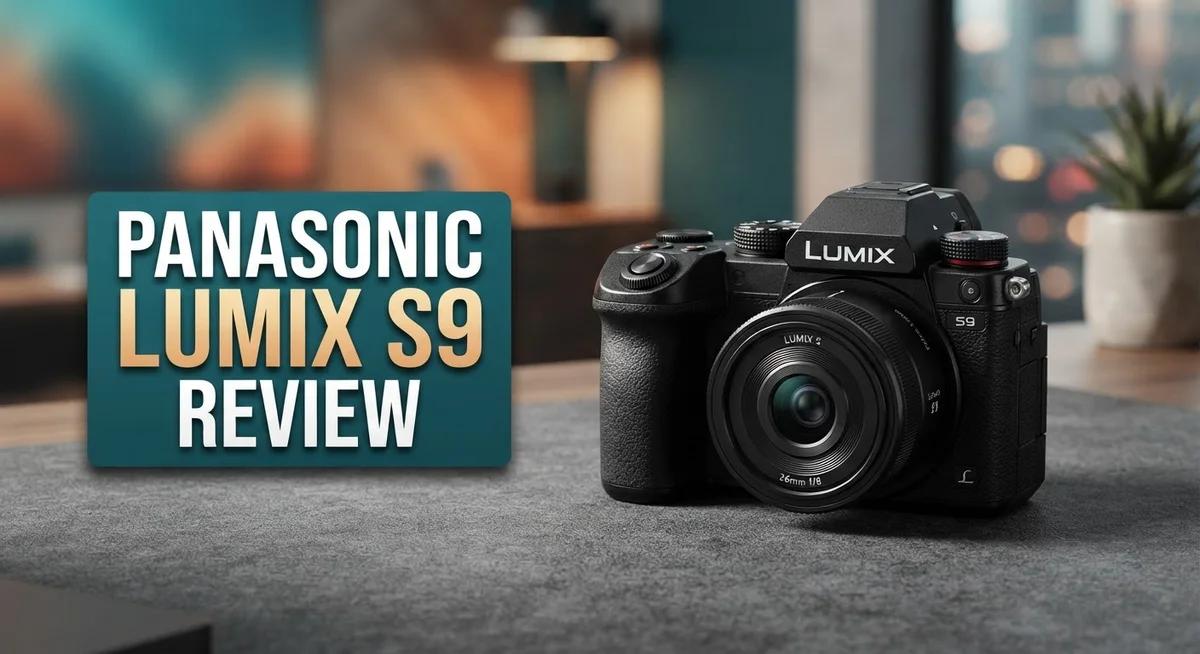
Panasonic Lumix S9 Review: Full-Frame Mirrorless Camera
Panasonic wants to put a full-frame sensor in your pocket. The Lumix S9 does just that.
This camera packs a 24.2MP full-frame CMOS sensor into a tiny, light body. It also shoots stunning 6K video.
Sounds perfect, right? Well, not so fast.
The S9 skips an electronic viewfinder. It also lacks a headphone jack and cold shoe. Some users even call the shooting experience frustrating.
Yet here is the twist. This camera became Panasonic’s best selling model. Buyers love it, even if some professionals do not.
So what makes the S9 so popular? Is it the compact design? Or the full-frame image quality in a small package?
This review digs into every detail. We will explore the pros, the cons, and everything between. You will know exactly what to expect before you decide.
In a Nutshell
Here is the quick rundown of the Panasonic Lumix S9. These points sum up what this camera offers and where it falls short.
-
Full frame power in a tiny shell. The S9 holds a 24.2MP sensor inside a compact and lightweight body. You get serious image quality without the bulk.
-
6K video ready. Content creators get strong video specs for vlogs and short films. The sensor handles detailed footage with ease.
-
Flexible lens choices. You can pair the S9 with the 18-40mm or the 20-60mm kit lens. Both options suit different shooting styles.
-
Storage that keeps up. The camera supports cards up to 256GB. That gives you room for long shooting sessions.
-
Some missing features. There is no electronic viewfinder, no headphone jack, and only one SD card slot. Power on time feels slow too.
-
A camera that still sells big. Despite these gaps, the S9 remains Panasonic’s best selling model. Many buyers value portability over extra features.
Sensor and Image Quality
The Panasonic Lumix S9 delivers genuine full-frame sensor performance in a body that fits your pocket. Its 24.2MP CMOS sensor captures sharp, detailed images with excellent color accuracy and dynamic range. You get the same sensor technology found in much larger professional cameras, but without the bulk.
Image quality shines in good lighting conditions. Colors pop naturally, and skin tones render beautifully. The sensor handles highlights well, giving you flexibility in post-processing. Low light performance is solid for a compact camera, though it doesn’t match larger full-frame systems with bigger lenses. You’ll notice grain appearing around ISO 3200 and beyond, which is typical for this sensor size.
The 6K video capability sets the S9 apart from many competitors. You can shoot smooth, detailed video for vlogs, short films, and content creation. The compact body makes handheld recording easier than with bulkier alternatives. Video autofocus tracks subjects reliably, though the lack of a headphone jack means you cannot monitor audio directly on the camera.
One challenge emerges when you shoot without an electronic viewfinder. You rely entirely on the rear screen to compose images. This makes framing difficult in bright sunlight and awkward for certain shooting angles. The screen itself is responsive and shows accurate colors, but it drains battery faster than an optical solution would.
The sensor’s real strength lies in its versatility. Pair it with the 18-40mm lens for everyday shooting, or choose the 20-60mm for more reach. Both lenses complement the sensor’s capabilities without adding excessive weight. RAW files give you maximum control in editing, and the 256GB storage support means you can shoot all day without changing cards.
The S9 proves that full-frame image quality doesn’t require a full-frame sized camera. It makes smart compromises in features like the viewfinder and connectivity to achieve portability. For photographers who value compact size and genuine sensor performance over traditional controls, this camera delivers impressive results. The popularity of the S9 among everyday users reflects this balanced approach to full-frame imaging.

- Ultra-Fast Connection and Transfer: Transfer content to your smartphone seamlessly with LUMIX Lab and an ultra-fast...
- Think Big, Pack Small: A small camera packed with professional-grade features; the perfect everyday companion as a...
- High Image Quality: LUMIX S9 full frame mirrorless digital camera delivers stunning professional results even in...

Last update on 2026-10-04 / Affiliate links / Images from Amazon Product Advertising API
Design and Portability
The Panasonic Lumix S9 breaks the mold for full-frame cameras. Most full-frame mirrorless systems weigh over two pounds. This camera tips the scales at just 650 grams with the battery and memory card included. You can slip it into a crossbody bag or backpack without feeling the extra weight.
The body measures 5.4 inches wide and 3.8 inches tall. It feels like holding a premium compact camera, not a professional workhorse. The grip sits naturally in your hand, even with smaller palms. The textured surface prevents accidental drops during outdoor shoots.
Panasonic kept the design clean and minimal. You get physical dials for key functions. The mode dial sits on top, while the exposure compensation dial lives on the back. This layout makes sense for quick adjustments without diving into menus.
The camera uses a fixed 3-inch LCD screen that tilts up and down. This vari-angle display helps when shooting from awkward positions. You can frame shots above your head or at ground level without contorting yourself. The screen flips down to face inward when closed, protecting it from scratches.
Build quality feels solid throughout. The magnesium alloy chassis resists minor bumps and weather exposure. The S9 handles light rain and dust, though it lacks full weatherproofing seals found on premium models.
One design choice stands out: the absence of an electronic viewfinder. Instead, you frame shots entirely through the rear screen. This saves weight and space but changes how you hold the camera. Some photographers adapt quickly. Others find it awkward after using traditional viewfinders.
The USB-C port sits on the left side. Battery charging happens via cable, not a dock. Memory card access requires opening the right panel. These placement choices keep the overall footprint small.
The S9 succeeds as a travel companion. It slips into situations where larger cameras draw attention. Professional photographers appreciate the portability for location work. Content creators love carrying it between multiple shooting locations throughout the day. The compact size makes the S9 genuinely different from other full-frame options on the market.
Video Capabilities and Recording
The Panasonic Lumix S9 brings serious video firepower to a camera that fits in your bag. 6K recording opens doors for content creators who want flexibility in post-production. You can crop, zoom, and reframe without losing quality. This capability separates the S9 from many competitors in the compact full-frame space.
Recording happens at various frame rates and resolutions. The S9 handles 4K smoothly for everyday projects. Step up to 6K when you need maximum detail or plan to color grade heavily. The sensor captures rich color information across the full frame. This matters when you’re shooting vlogs, short films, or travel content.
Codec options let you choose between quality and file size. You can record to SD cards up to 256GB, so storage keeps pace with your ambitions. One limitation surfaces here: the single SD card slot means you cannot record to two cards simultaneously. Professionals often want backup recording or longer uninterrupted takes.
Audio recording presents a real challenge. The missing headphone jack prevents real-time monitoring of your sound levels. You cannot hear what the microphone picks up while filming. This frustrates users who care about audio quality. External recorders become necessary for serious sound work.
The fixed LCD screen tilts, which helps when shooting at awkward angles. Vlogging becomes manageable even without a flip-out screen. The display shows focus peaking and exposure information. These tools help you nail focus during video work.
Autofocus performs well during recording. The contrast-based system tracks moving subjects reasonably. It does not match the speed of phase-detection systems in some competitors. Fast-moving action sometimes causes hunting or lag.
Heat management stays solid during extended shoots. The compact body does not overheat like some full-frame cameras. You can record longer sessions without thermal shutdown. This reliability makes the S9 practical for content production.
The video experience feels incomplete without headphone monitoring. Yet the 6K capability and reliable autofocus deliver genuine creative tools. The S9 suits creators who prioritize portability over every professional feature.
Top 3 Alternatives
Sony Alpha 7C II

- Incredibly compact and lightweight, packed with full-frame performance
- 33.0MP full-frame Exmor R CMOS sensor
- BIONZ XR processing power for exceptional image quality
Last update on 2026-10-04 / Affiliate links / Images from Amazon Product Advertising API
The Sony Alpha 7C II brings compact design with full-frame power. This camera fits easily in your bag while delivering professional image quality. The 33-megapixel sensor captures sharp details in various lighting conditions. Fast autofocus helps you catch moments without delay. The compact body makes it perfect for travel photographers and content creators who move around frequently.
Real-time tracking keeps your subject in focus automatically. The electronic viewfinder shows you exactly what the final image will look like. Battery life lasts through a full day of shooting. You get reliable performance in both stills and video modes.
Canon EOS R6 Mark II

- FULL-FRAME CMOS SENSOR: 24.2 effective megapixels (approx.) lets you capture sharp, detailed images even in...
- DIGIC X IMAGE PROCESSOR: Enhances digital camera performance and processes, including image stabilization, image...
- HIGH-SPEED CONTINUOUS SHOOTING: Electronic shutter speeds of up to 40 fps at 20MP let you capture dynamic action...
Last update on 2026-10-04 / Affiliate links / Images from Amazon Product Advertising API
The Canon EOS R6 Mark II offers excellent all-around performance for professionals and enthusiasts. Its 20-megapixel sensor balances speed and file size effectively. The camera handles fast continuous shooting without breaking a sweat. Weather sealing protects your gear during outdoor adventures.
Canon’s autofocus system tracks moving subjects with impressive accuracy. The built-in image stabilization keeps your handheld shots steady. You can shoot 4K video smoothly with professional controls. The battery performs well through extended shooting sessions.
Nikon Z6 III

- VIDEO - 6K/60p Internal N-RAW video recording + oversampled 4K UHD, 4K/120p, Full HD/240p slow motion, Hi-Res Zoom...
- BEST IN CLASS EVF - Max brightness of 4000 nits gives a clear, vibrant view even in very bright conditions...
- WIDE ISO RANGE - ISO sensitivity range of 100-64000, with extended range up to Hi 1.7 (equivalent to ISO 204800).
Last update on 2026-10-04 / Affiliate links / Images from Amazon Product Advertising API
The Nikon Z6 III delivers impressive speed and reliability. The 24.2-megapixel sensor produces clean images across all ISO levels. Burst shooting captures up to 14 frames per second, perfect for action photography. The autofocus system includes animal eye detection for wildlife work.
Build quality feels solid and durable. The viewfinder provides a clear, bright view of your scene. Video capabilities include 8K recording options for future-proof content. Dual SD UHS-II card slots give you backup storage security.
Viewfinder and User Interface
The Panasonic Lumix S9 uses a fixed 3-inch LCD screen as its main viewing tool. This tilting display lets you shoot at different angles without awkward positioning. The screen flips up and down smoothly, which proves helpful when you frame shots from your hip or above your head.
One major limitation stands out here: the S9 has no electronic viewfinder. You rely entirely on the rear LCD for composition and focus. Some shooters find this frustrating because you lose the immersive viewfinder experience that most mirrorless cameras offer. Outdoor shooting in bright sunlight can make the LCD harder to see, though the screen’s brightness helps.
The menu system feels straightforward and logical. Panasonic organized buttons and controls so you access common settings quickly. The joystick on the back lets you navigate menus and select focus points with one thumb. Function buttons sit within easy reach, so you don’t fumble through layers of menus during a shoot.
Autofocus performance during live view works well. The camera tracks subjects smoothly across the frame. You see focus peaking on the LCD, which helps confirm sharp focus before you press the shutter. Face detection and eye-tracking perform reliably in good light.
The USB-C port sits on the left side of the body. This placement keeps cables out of your way during shooting. Battery life runs decent for a compact full-frame camera, though extended video work drains power faster than stills.
The overall interface feels clean and minimal. Panasonic avoided cluttering the body with unnecessary buttons. This design philosophy makes the S9 feel less intimidating for beginners. Experienced photographers appreciate the direct access to key controls.
The lack of a headphone jack creates a real gap. You cannot monitor audio during video recording without external solutions. This omission frustrates content creators who need reliable sound monitoring. The shooting experience feels complete for stills but incomplete for serious video work without workarounds.
Storage and Connectivity
The Panasonic Lumix S9 keeps storage straightforward with its single SD card slot. This design choice limits flexibility when you shoot extended sessions or work on multiple projects simultaneously. You’ll need to manage your cards carefully during long shoots.
The camera supports SD, SDHC, and SDXC cards up to 256GB capacity. This maximum storage space gives you plenty of room for photos and 6K video files. Larger cards mean fewer interruptions when capturing content throughout your day.
Recording 6K video creates substantial file sizes. You should invest in fast, reliable cards rated for high-speed writing. Standard cards may struggle with the camera’s video output, causing potential dropped frames or recording interruptions. UHS-II cards work best for consistent performance during demanding shoots.
USB-C connectivity sits on the left side of the body. This port handles both charging and data transfer, making workflow integration simple. You can connect to computers, external storage devices, or power banks without additional adapters. The single port approach keeps the design minimal but requires you to choose between charging and file transfer at any given moment.
The S9 lacks a headphone jack entirely. This absence affects audio monitoring during video recording. You cannot listen to your sound levels in real time, which creates challenges for serious videographers. External audio solutions require workarounds or alternative monitoring methods.
Wireless connectivity options remain limited on this model. The camera does not include built-in WiFi or Bluetooth for remote control or quick file sharing. This omission means you must physically connect the camera to transfer images to your computer or mobile device.
The overall connectivity setup reflects Panasonic’s minimalist philosophy. Single SD card slot, USB-C only, and no wireless options keep the body compact and lightweight. This approach works well for photographers who value portability over convenience features. However, professionals managing high-volume shoots or requiring extensive connectivity may find these limitations restrictive.
Pros and Cons
Pros
- Full frame 24.2MP sensor packed into a genuinely portable body that fits travel bags
- 6K video recording gives you serious creative options without needing larger gear
- Compact design makes it a legitimate alternative to bulkier mirrorless systems
- Straightforward menu system keeps shooting simple and intuitive
- Solid autofocus performance works reliably during both photos and video
Cons
- No electronic viewfinder means you rely entirely on the rear LCD screen for framing
- Single SD card slot limits backup options during extended shoots
- Slow power on time creates frustrating delays before you can start shooting
- Missing headphone jack removes audio monitoring during video recording, creating a real gap in the workflow
Who Should Buy It
The Panasonic Lumix S9 works best for specific types of photographers. Travel shooters love this camera. You get full frame power in a body that fits easily into backpacks and carry-on luggage. The compact design means you can shoot serious projects without the bulk of traditional mirrorless systems.
Content creators who prioritize portability should consider this model. The 6K video capability lets you capture professional quality footage. You won’t need to carry multiple camera bodies to handle different shooting scenarios. The lightweight frame reduces fatigue during long shooting days.
Street photographers find real value here. The fixed LCD screen and minimal controls keep your workflow simple. You can focus on composition rather than wrestling with complex menus. The straightforward interface means less time adjusting settings and more time capturing moments.
Vloggers and solo video producers appreciate the compact form factor. The 6K recording gives you flexibility in post production. You can crop and reframe shots without losing quality. The clean design lets you mount accessories without excessive bulk.
However, the S9 is not ideal for certain users. Professional studio photographers need electronic viewfinders and extensive connectivity options. The missing headphone jack creates real problems for serious audio monitoring during video work. The single SD card slot frustrates anyone shooting extended projects without backup options.
Sports and wildlife photographers should look elsewhere. The slow power on time costs you crucial moments. The lack of a cold shoe limits your ability to attach external equipment quickly. These limitations add friction during fast paced shooting.
Hybrid shooters who demand both photography and video excellence should compare alternatives first. The missing features create workflow gaps. The fixed LCD screen causes problems when shooting at awkward angles or in bright sunlight.
The S9 succeeds for minimalist shooters who value portability above all else. You need to accept the limitations and work within them. This camera rewards photographers who travel frequently and prioritize compact design. It punishes those who demand maximum connectivity and professional level accessories.
Final Verdict
The Panasonic Lumix S9 sits in an interesting spot. It offers full frame image quality in a tiny shell. That combination alone makes it stand out from typical mirrorless cameras.
Still, the missing features add up. No cold shoe means you cannot easily attach microphones or lights without extra adapters. This limits creative setups for vloggers who need more gear.
Some users also report a frustrating shooting experience overall. Menu delays, slow startup, and missing physical controls can break your creative flow. These issues matter if you shoot fast moving scenes often.
Despite these flaws, the S9 remains Panasonic’s best selling camera. That fact alone tells a story. Many photographers accept small tradeoffs for extreme portability.
Professionals often criticize the S9 for cutting too many corners. Casual shooters and travel creators see it differently. They value size and simplicity over a long list of features.
If you want a serious hybrid system for sports or wildlife, look at other full frame options. The S9 was never built for that kind of demanding work.
If you want something closer to a premium compact camera, the Fujifilm X100VI deserves a look too. It offers a sharper APS-C sensor and a more traditional shooting experience.
So who should actually buy the S9? Minimalist creators who want full frame quality without bulk will love it. Those who shoot photos and videos on the move benefit most.
People who need a camera that can do everything perfectly should keep searching. The S9 makes clear compromises to stay small and simple.
In short, the Panasonic Lumix S9 rewards users who value portability above raw performance. It is not a perfect camera. It is a smart choice for a specific kind of photographer who puts freedom of movement first.
Frequently Asked Questions
Does the Panasonic Lumix S9 have an electronic viewfinder?
No, it does not. The S9 relies entirely on the rear LCD screen for framing your shots. This design choice keeps the camera compact, but it means you lose the traditional viewfinder experience many photographers expect from a full-frame mirrorless camera.
How long does the S9 take to power on?
The power-on time is noticeably slow. Many users report frustrating delays before the camera is ready to shoot. If you need instant responsiveness for fast-moving situations, this limitation becomes a real problem during critical moments.
Can I use two SD cards for backup storage?
No. The S9 has only a single SD card slot. This limits your backup options during extended shoots or travel. You’ll need to manage storage more carefully or bring additional cards to swap out.
What video formats does the S9 shoot?
The camera records in 6K video, giving you serious creative flexibility for content creation. This capability stands out in its class and appeals to vloggers and video producers who want professional quality without hauling larger equipment.
How does the S9 compare to the Fujifilm X100VI?
The X100VI is a premium compact with a 40.2MP APS-C sensor and a fixed lens design. The S9 offers full-frame capability and interchangeable lenses instead. The X100VI suits photographers who want a finished, self-contained system. The S9 appeals to minimalists seeking full-frame versatility in a portable package.

Sili is a tech reviewer who cuts through the hype to find AI tools and gadgets that make life easier. She shares honest reviews and simple guides for everyday tech users.

