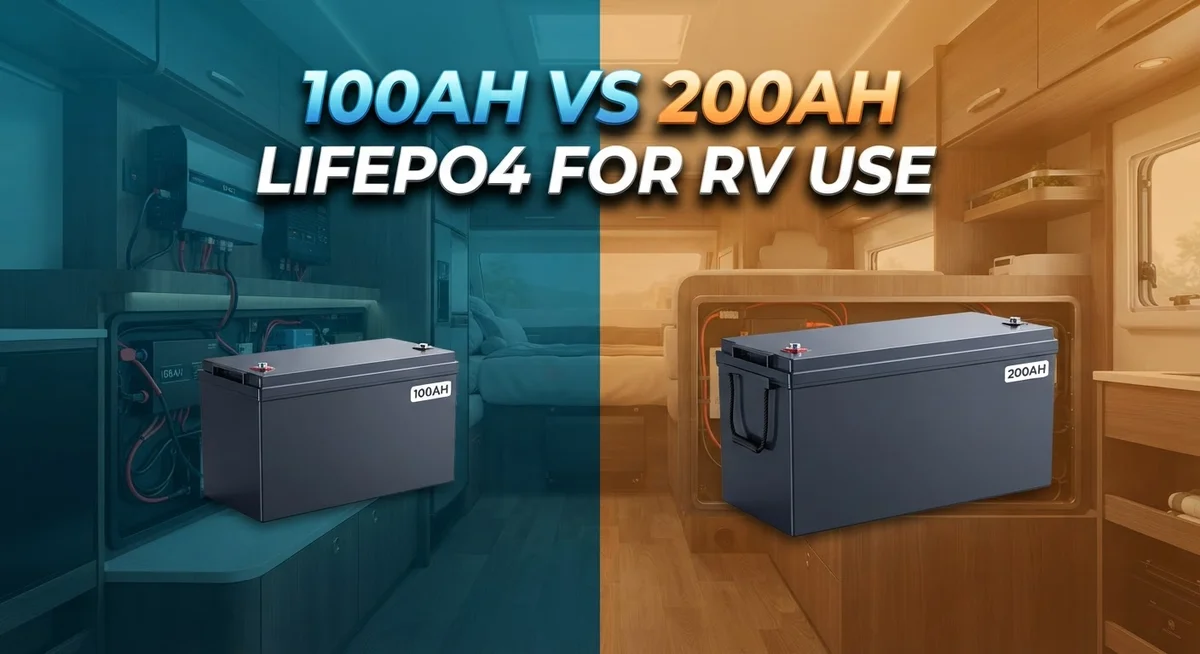
100Ah vs 200Ah LiFePO4 for RV Use: Which Battery Capacity Fits Your Needs
Picking the right battery for your RV matters. It affects how long your fridge runs and how comfortable your trips feel.
Two popular choices stand out in the LiFePO4 world: 100Ah and 200Ah. Both offer clean power and long life.
But they serve different needs.
The 100Ah battery works well for small RVs and weekend getaways. It stays light and handles minimal loads with ease.
The 200Ah battery steps up for full-time RV living. It powers multiple appliances and supports extended off-grid adventures.
This guide breaks down specs, strengths, and weaknesses for both options. You will see how each battery performs with real RV loads like fridges, fans, and lights.
By the end, you will know which capacity matches your travel style. Whether you camp occasionally or live on the road, we will help you choose the right fit for your rig.
Quick Comparison: 100Ah vs 200Ah LiFePO4 for RV Use
| Feature | 100Ah | 200Ah LiFePO4 for RV Use |
|---|---|---|
| Capacity | 100Ah (5-hour rating) | 200Ah (double capacity) |
| Nominal Voltage | 12.8V | 12.8V |
| Max Charging Current | 100A | 200A |
| Runtime Duration | ~2 days at 50% depletion | Extended off-grid autonomy |
| Weight Profile | Lighter weight | Heavier than 100Ah |
| Ideal Use Case | Weekend trips, small RVs | Full-time living, extended trips |
| Appliance Support | Minimal loads only | Multiple appliances supported |
| Total Cost of Ownership | Lower initial investment | Better long-term value |
100Ah

- MAINTENANCE FREE: 12.99x 6.73x 8.43 inches. Weize 12v 100Ah sealed lead acid battery is manufactured with absorbent...
- OPERATING TEMPERATURE: Charging Temp ranges from 14℉ (-10℃) to 122℉ (50℃), discharging Temp ranges from...
- LONGER LIFESPAN: Compared with flooded counterparts, its lower self-discharge of 1-3% per month allows long storage...
Last update on 2026-09-19 / Affiliate links / Images from Amazon Product Advertising API
100Ah LiFePO4 Battery
A 100Ah LiFePO4 battery delivers 1,280 watt-hours of usable energy at 12.8V nominal voltage. This capacity suits small RV setups, weekend warriors, and travelers with minimal appliance loads.
The battery accepts up to 100A charging current and maintains stable output down to 12V discharge voltage. Its lighter weight makes installation straightforward in compact RV frames without requiring heavy structural modifications.
Real-world performance shows this battery powers essential systems like fridges, fans, and LED lights for roughly two days before dropping to 50% capacity with typical RV consumption patterns. For short trips and light usage, this runtime proves sufficient and reliable.
Build quality in LiFePO4 chemistry means 3,000+ charge cycles and superior safety compared to lead-acid alternatives. Weekend adventurers appreciate the maintenance-free operation and instant availability without the sulfation issues of traditional batteries.
Pros
- Lightweight and easy to install in smaller RV compartments
- Handles quick charging at 100A maximum current rate
- Ideal for weekend trips and minimal electrical loads
- Long cycle life with minimal maintenance required
Cons
- Runtime depletes to 50% in about two days under normal RV loads
- Insufficient for extended off-grid adventures or full-time living
- Limited capacity for powering multiple appliances simultaneously
200Ah LiFePO4 for RV Use

- 15-Year Lifespan and Reliable Performance: Rvpozwer 12.8V 200Ah LiFePO4 battery provides deep cycles, offering...
- Superior Power with Protection: Our 200Ah battery uses Grade-A LiFePO4 cells for exceptional energy density and...
- Compact, Expandable Power: Our 12V lithium battery delivers flexible, scalable energy. Connect up to 4 in series...
Last update on 2026-09-19 / Affiliate links / Images from Amazon Product Advertising API
The 200Ah LiFePO4 battery delivers 2,560 watt-hours of usable energy at 12.8V nominal voltage. This doubled capacity makes it the powerhouse choice for RV owners who demand extended autonomy and refuse to compromise on comfort.
This battery excels for full-time RV living and extended off-grid adventures where multiple appliances run simultaneously. It enables your fridge to operate overnight before departure and keeps essential systems running for days without external power.
Build quality in LiFePO4 chemistry means 3,000+ charge cycles and superior safety compared to lead-acid alternatives. The battery handles demanding discharge rates while maintaining stable output down to 12V, ensuring reliable performance in real-world RV conditions.
Real-world performance shows this battery powers fridges, fans, water pumps, and LED lighting systems for several days on a single charge with typical RV loads. Weight reduction versus lead-acid equivalents makes installation practical, even in compact RV compartments designed for smaller batteries.
Pros
- Doubles available energy storage compared to 100Ah models
- Enables overnight fridge operation and multi-day off-grid trips
- Significant weight reduction versus lead-acid battery equivalents
- Lower total cost of ownership over the battery’s 10+ year lifespan
Cons
- Higher upfront investment than smaller capacity options
- May be overkill for minimal-load setups and weekend-only use
Head to Head: Key Differences
The main difference between these two batteries comes down to how long you can stay off the grid. A 100Ah battery holds 1,280 watt-hours, while a 200Ah battery doubles that to 2,560 watt-hours.
This matters because your RV’s daily power draw determines how many days you can travel without recharging.
With a 100Ah model, expect to deplete the battery to 50% capacity within about two days under typical RV loads. Your fridge, fan, and lights will run fine, but you’ll need a generator or solar panels to top up regularly.
This setup works best if you move frequently or camp near shore power.
A 200Ah battery keeps essential systems running for several days without recharging. You can leave the fridge on overnight, run water pumps, and power multiple devices simultaneously.
This flexibility makes it ideal for remote camping trips where you won’t see a charging station for days.
Weight is another practical consideration. The 100Ah model stays lighter and easier to install in tight compartments.
The 200Ah version weighs more but still offers significant weight savings compared to lead-acid equivalents. Most modern RVs can handle the extra load without suspension issues.
Charging speed differs slightly too. Both accept up to 100A charging current, but the 200Ah battery takes longer to reach full capacity.
With a 400W solar array, the 100Ah charges faster, while the 200Ah needs more panels or charging time.
Your choice depends on travel style. Pick 100Ah for weekend trips and minimal loads.
Choose 200Ah if you live full-time in your RV or venture far from civilization. Both offer 3,000+ charge cycles and superior safety compared to older battery chemistries.
Which One Should You Buy
The 200Ah LiFePO4 battery is our overall winner for RV use. It gives you substantially more energy autonomy than the 100Ah option.
This means you can run multiple appliances at once. You will not need to recharge as often, even during extended off-grid trips.
For most RV owners, this extra capacity makes daily life easier. It supports a more flexible and worry-free travel experience.
Best for each buyer – 100Ah LiFePO4: This battery suits weekend travelers or small RV owners. It works well for short trips with minimal appliance use. – 200Ah LiFePO4: This battery suits full-time RVers and off-grid adventurers.
It handles multiple appliances and long trips with ease.
Frequently Asked Questions
How long will a 100Ah battery last in my RV?
A 100Ah LiFePO4 battery depletes to 50% capacity in roughly two days with standard RV loads. Your actual runtime depends on what you run.
A fridge, fan, and LED lights consume power steadily. If you move frequently or camp near shore power, this battery works well.
You’ll need to recharge every couple of days for extended trips.
Can I run multiple appliances on a 200Ah battery?
Yes. A 200Ah battery stores double the energy of a 100Ah model.
This means you can run your fridge, water pump, fan, and lights simultaneously without draining power too fast. Multiple appliances work together without stress. You get several days of off-grid operation before recharging becomes necessary.
Which battery is lighter to install?
The 100Ah battery weighs significantly less than a 200Ah model. If your RV has tight compartment space or weight limits, the 100Ah fits easier.
However, the 200Ah still offers major weight savings compared to old lead-acid batteries. Installation difficulty is similar for both LiFePO4 options.
Should I choose 100Ah if I only take weekend trips?
Yes, a 100Ah battery suits weekend travelers well. You’ll camp close to civilization and recharge frequently.
This battery handles your fridge and basic lights without strain. However, if you ever plan longer trips, the extra capacity of a 200Ah gives you flexibility for future adventures.
What’s the lifespan difference between these batteries?
Both LiFePO4 batteries deliver 3,000+ charge cycles and outlast lead-acid alternatives by years. The 200Ah doesn’t degrade faster than the 100Ah.
Chemistry quality remains identical. Your choice depends on power needs, not longevity.

Sili is a tech reviewer who cuts through the hype to find AI tools and gadgets that make life easier. She shares honest reviews and simple guides for everyday tech users.